Leonardo da Vinci · 1452–1519 · six sheets and a book
Read It in a Mirror
鏡書
What does a mind look like while it is still working?
Only a small number of paintings by Leonardo survive. What he left in quantity is paper. The Met holds a handful of his sheets, none much larger than a hand, and they show habits more than masterpieces: he watched animals, tried one idea again and again, changed a face halfway through, and wrote from right to left. An old mount for one of these sheets, inscribed in an early nineteenth-century French hand, says it plainly: the writing “doit se lire dans une glace”, must be read in a mirror.
Try his direction
Leonardo was left-handed, and his notes run from right to left, “as is usual for Leonardo”, in the words of the Met’s curators. The letters are reversed too, so a mirror sets them right. Why he wrote this way is still argued over. What it does to a reader is simple: it slows you down.
Read it in a mirror
Shown flipped left to right, the way his notes look on the page.
Everything in this room, at the same scale
Sizes as the museums record them: each sheet’s height and width, and the closed book’s binding. Each picture is fitted inside its outline without cropping.
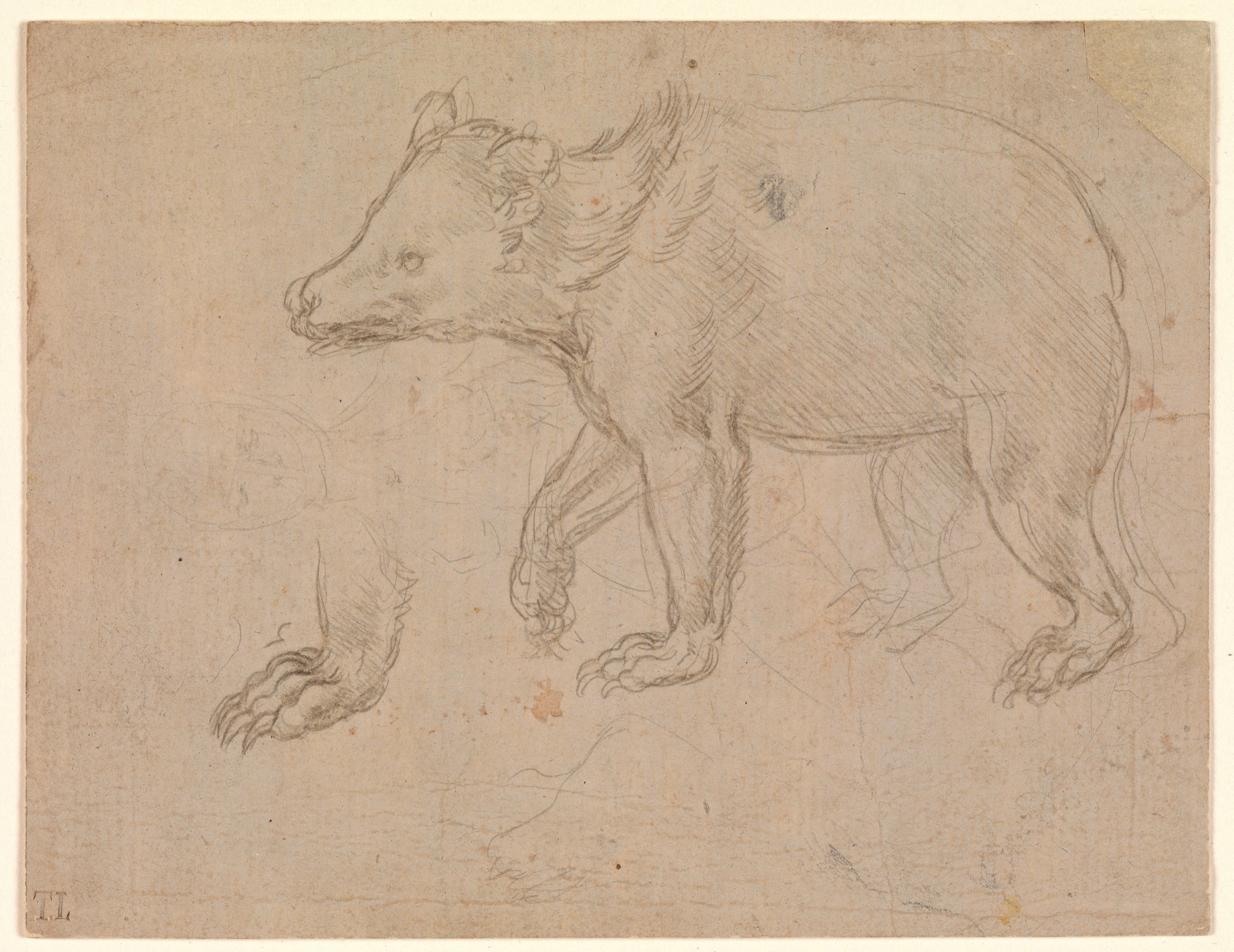
The Met thinks he probably drew this from life, and that dissecting bears may have helped his understanding of the animal. It belongs with bear studies for an anatomical treatise he planned, about which he wrote: I will discourse of the hands of each animal to show in what way they vary, as in the bear which has the ligatures of the toes joined above the instep. Beneath the bear, the faint outlines of a seated woman show that he reused the sheet.
A reading
Silverpoint is hard to erase, so every line here was a decision. He gives the bear a heavy, careful walk, then draws one paw again beside it, larger, as if the first try had not answered his question. Look under the bear and you can just find another drawing, a seated woman nobody finished. Paper was precious. So, apparently, was the bear.
Museum record
Leonardo da Vinci A Bear Walking, ca. 1482–85 Silverpoint on light buff prepared paper · 10.3 × 13.3 cm The Metropolitan Museum of Art · Robert Lehman Collection, 1975 · 1975.1.369
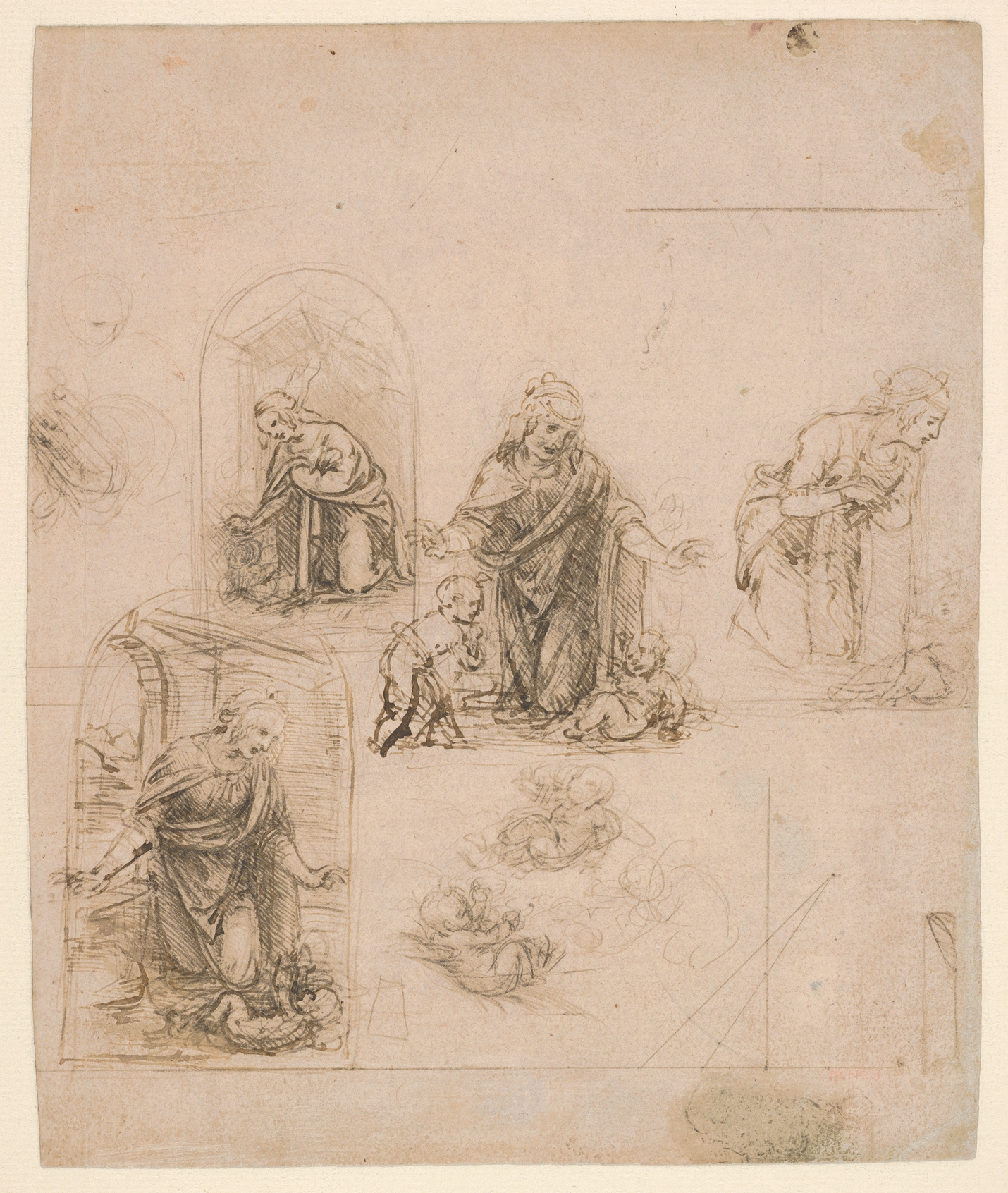
The Met calls these dazzling sketches of the Virgin kneeling before the Christ Child, a theme Leonardo would also use in the Virgin of the Rocks. He worked in silverpoint and reinforced the shadows with pen. The geometric lines at lower right are his attempts to work out the perspective from the viewer’s point of view.
A reading
She kneels in an arched niche; again in the open, with two children; again, turning away; and once more in a second arch. Between them, babies drawn in quick loops. This is what deciding looks like before anything is decided: not one picture but several, all allowed to stay on the page. In the corner, ruled lines try to work out where you, the viewer, will stand.
Museum record
Leonardo da Vinci Compositional Sketches for the Virgin Adoring the Christ Child, with and without the Infant St. John the Baptist; Diagram of a Perspectival Projection (recto), 1480–85 Silverpoint, partly reworked by the artist with pen and dark brown ink on pink prepared paper · 19.3 × 16.2 cm The Metropolitan Museum of Art · Rogers Fund, 1917 · 17.142.1
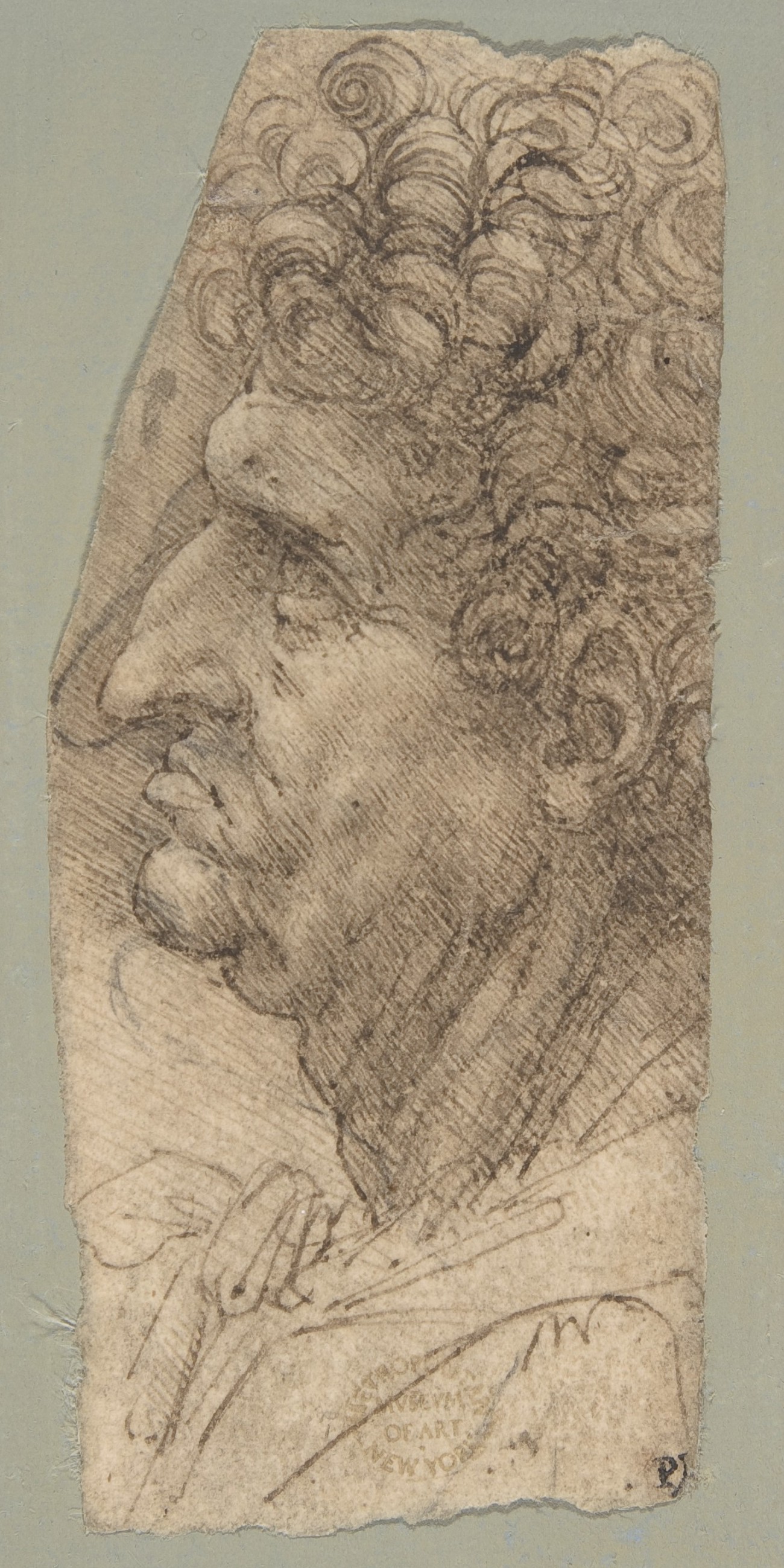
The Met explains that Leonardo began this head in charcoal or soft black chalk as the hooked profile of a grotesque old man, then reworked it in pen and ink into a younger man. The most dramatic change occurs in the nose, which in the pen-and-ink drawing appears shorter and straighter.
A reading
This scrap holds two people. Underneath, in soft chalk, an old man with a hooked nose; on top, in ink, someone younger, the nose cut back and straightened. He did not throw the first face away. He drew through it, and every confident line on top is also a correction.
Museum record
Leonardo da Vinci Head of a Man in Profile Facing to the Left, 1490–94 Pen and brown ink, over soft black chalk · 11.7 × 5.2 cm The Metropolitan Museum of Art · Rogers Fund, 1909 · 10.45.1
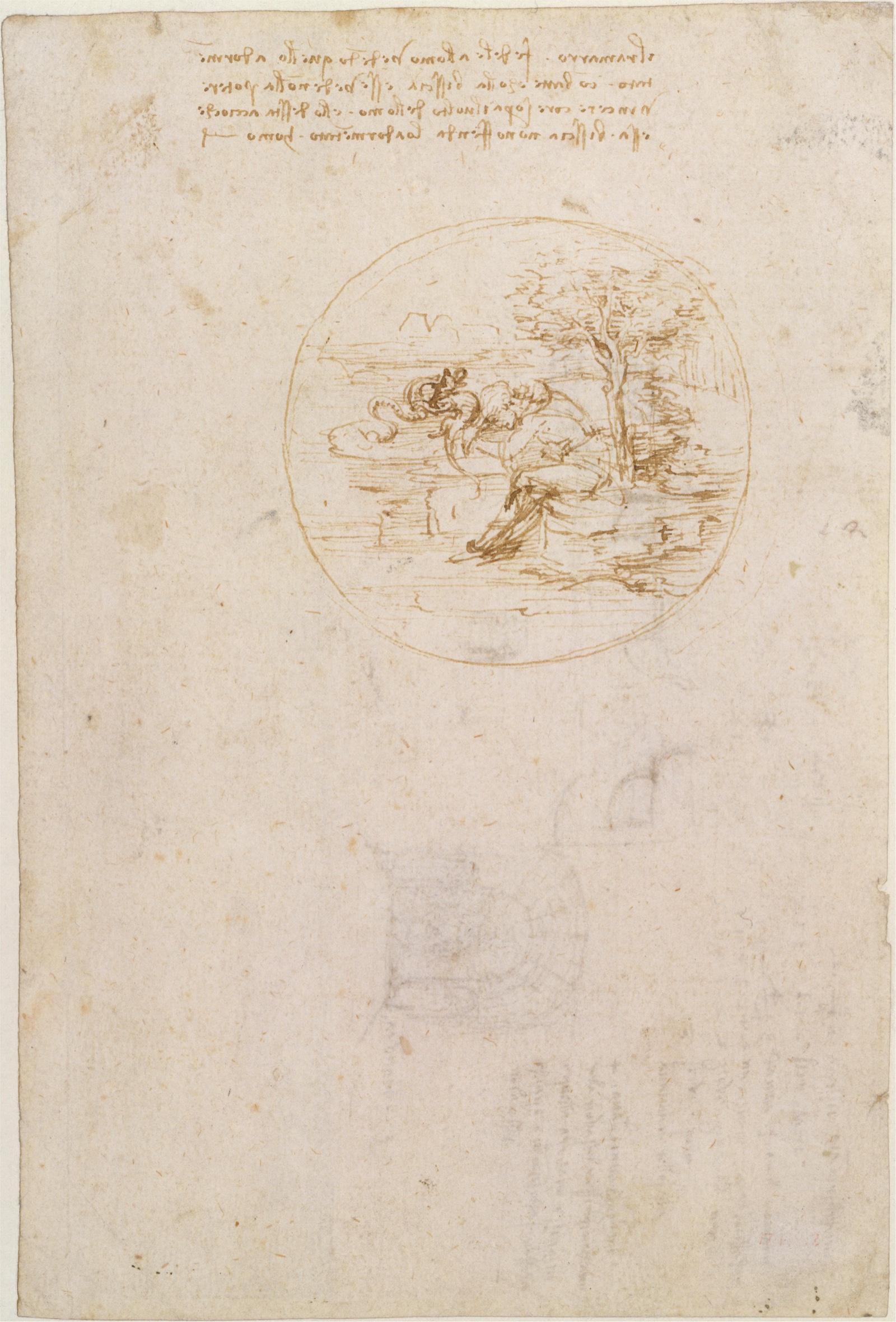
il ramarro . fedele allomo vede[n]do quello adorme[n]/tato . co[n] batte . cholla bisscia esse vede no[n]lla potere / vincere core sopra il uolto dello mo . ello dessta accioche / essa . bisscia no no ffenda loadorme[n]tato . homo.
“The green lizard, faithful to man, seeing him asleep, fights the grass snake; and if it sees it cannot overcome it, it runs over the man’s face and wakes him, so that the snake may not harm the sleeping man.”
Transcription as published by the Met; translation mine.
From the museum
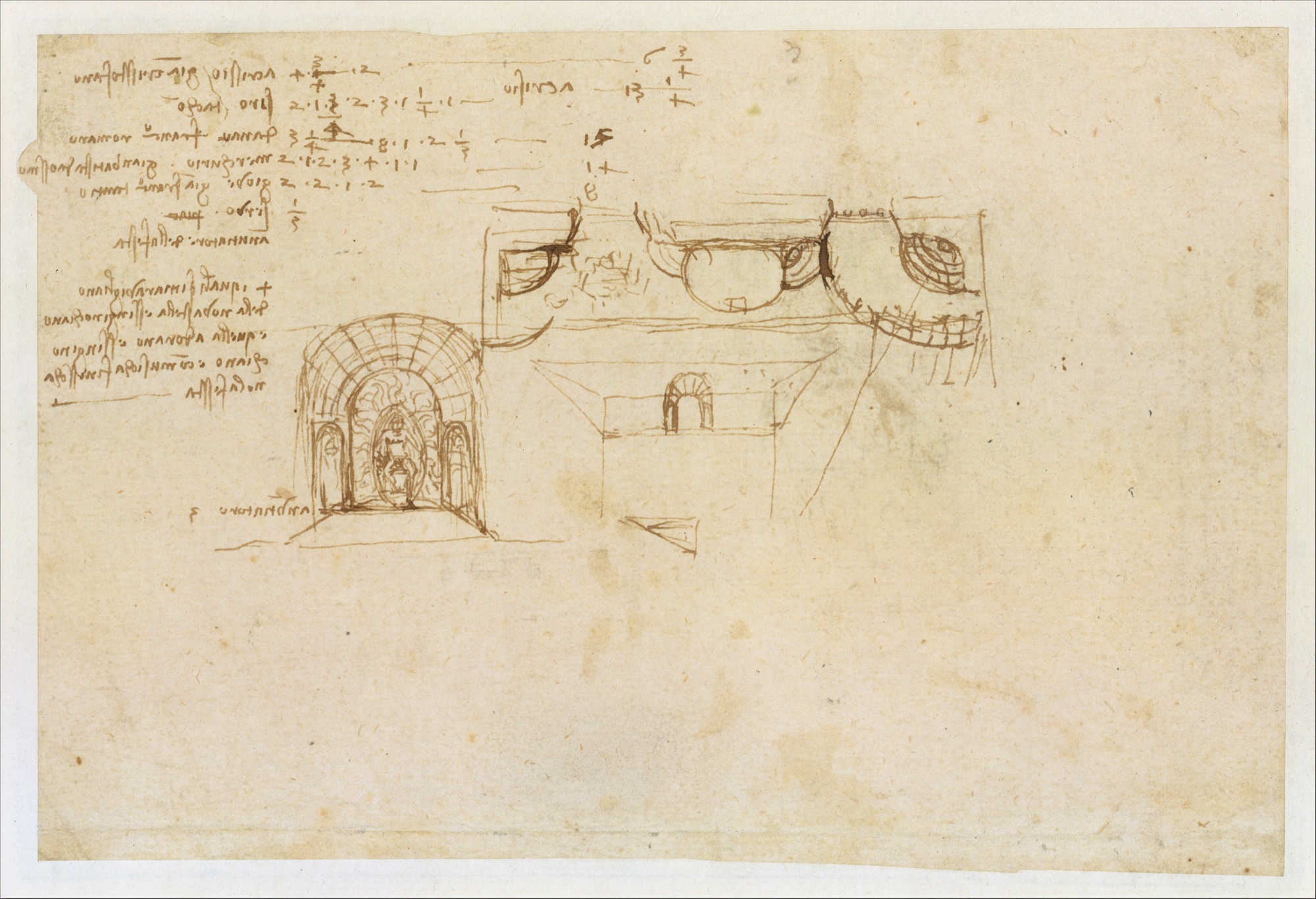
The Met describes the little round scene on the front as intended for a medal on a theatrical costume. The back holds Leonardo’s working sketches for staging La Danae, a comedy by Baldassare Taccone performed on 31 January 1496: a list of actors at upper left with measurements for where each should stand, as is usual for Leonardo written from right to left, and the stage drawn as an elevation, a plan and a bird’s-eye view.
A reading
One side of this sheet is a fable, the other a backstage plan. On the front, a lizard keeps watch over a sleeping man and, if it cannot win the fight, runs across his face to wake him. On the back, Leonardo works out where each actor should stand for a comedy at court. Hold up the mirror and his hand turns readable, though still in his own Italian spelling, which no mirror can modernise.
Museum record
Leonardo da Vinci Allegory on the Fidelity of the Lizard (recto); Design for a Stage Setting (verso), 1496 Pen and brown ink (recto and verso) · 20.2 × 13.3 cm The Metropolitan Museum of Art · Rogers Fund, 1917 · 17.142.2
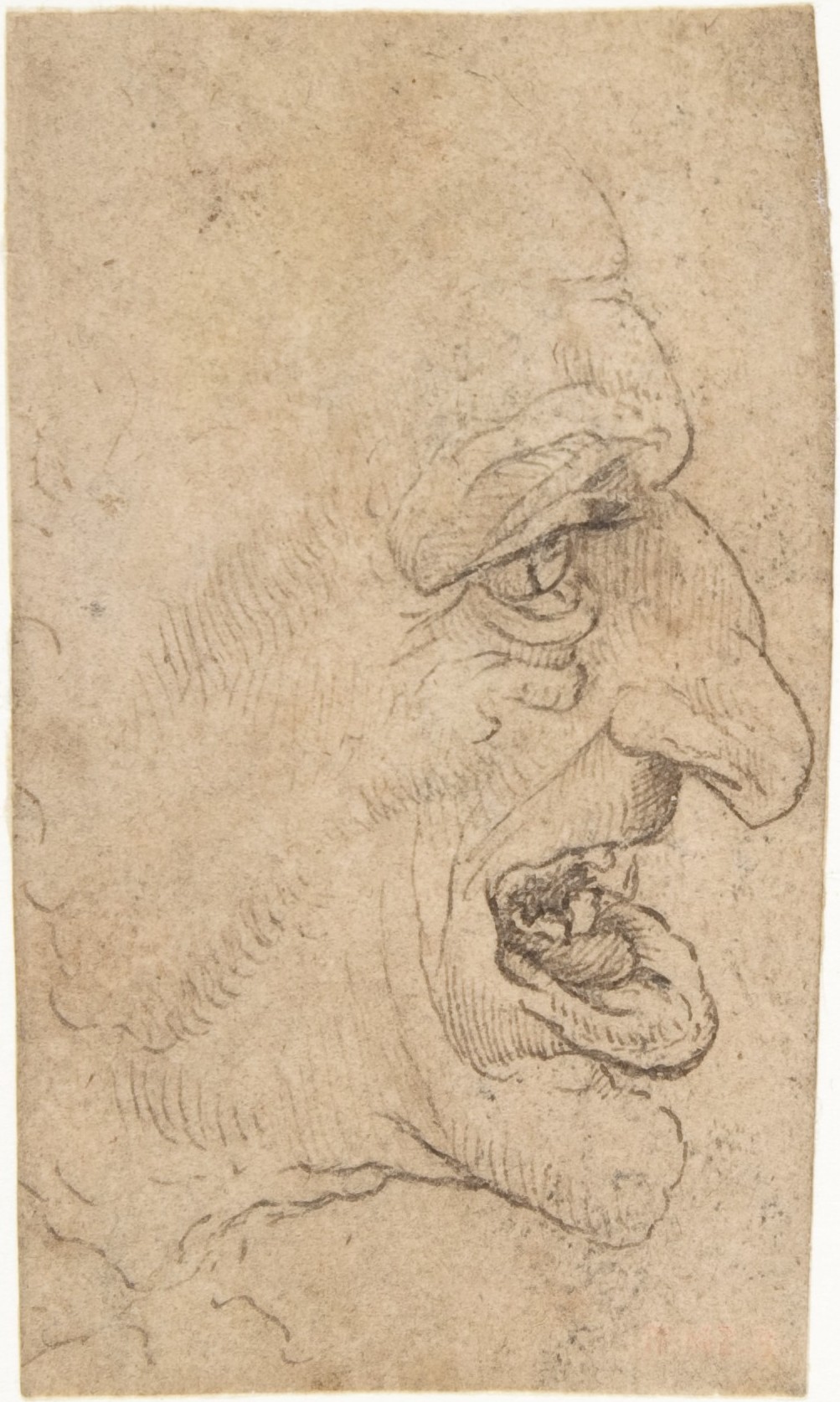
When the Met acquired the lizard sheet in 1917, this small head was discovered beneath it. The lizard sheet was then hinged to an old blue mount whose French inscription says the writing must be read in a mirror. The Met catalogues the head as after Leonardo, a follower’s work, dry and awkward in execution.
A copy that travelled pressed against the real thing. Even his imitators kept his company.
After Leonardo da Vinci The Head of a Grotesque Man in Profile Facing Right, after 1500 Pen and brown ink, on off-white paper (now darkened) · 9.2 × 5.4 cm The Metropolitan Museum of Art · Rogers Fund, 1917 · 17.142.3
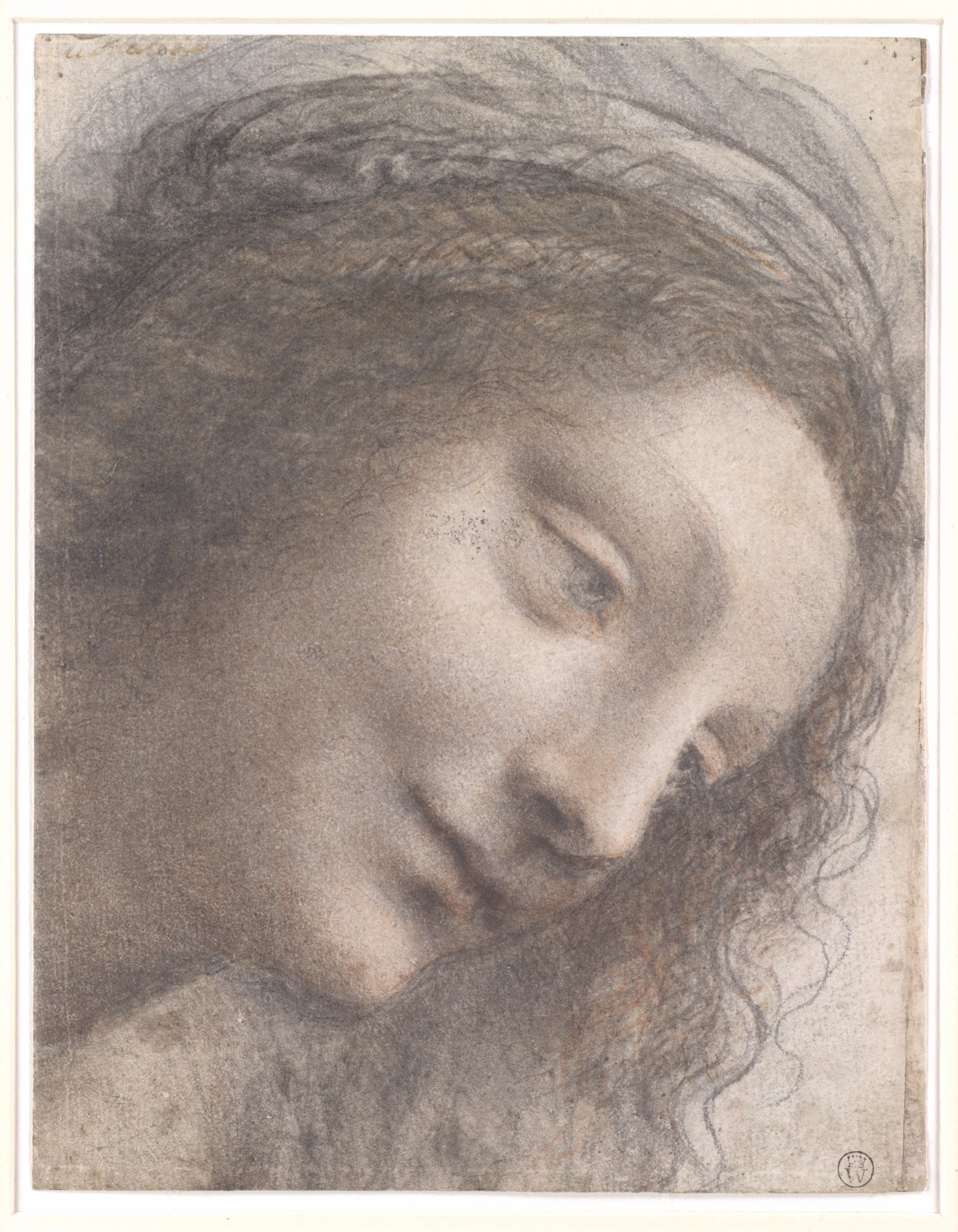
Some scholars doubted this drawing, perhaps, the Met suggests, because its magical beauty renders it suspicious. Scientific study in 2002–3 found a nearly seamless sfumato with extensive left-handed strokes in the rubbed-in shadows, and the Met concludes that the drawing must unquestionably be authentic.
A reading
Late in his life the lines almost disappear. Shadow turns into skin without an edge you could point to. That softness was the reason for doubt, and it was also where the proof was hiding: underneath the haze, strokes laid down by a left hand. His.
Museum record
Leonardo da Vinci The Head of the Virgin in Three-Quarter View Facing Right, 1510–13 Black chalk, charcoal, and red chalk, with some traces of white chalk (?) · 20.3 × 15.6 cm The Metropolitan Museum of Art · Harris Brisbane Dick Fund, 1951 · 51.90
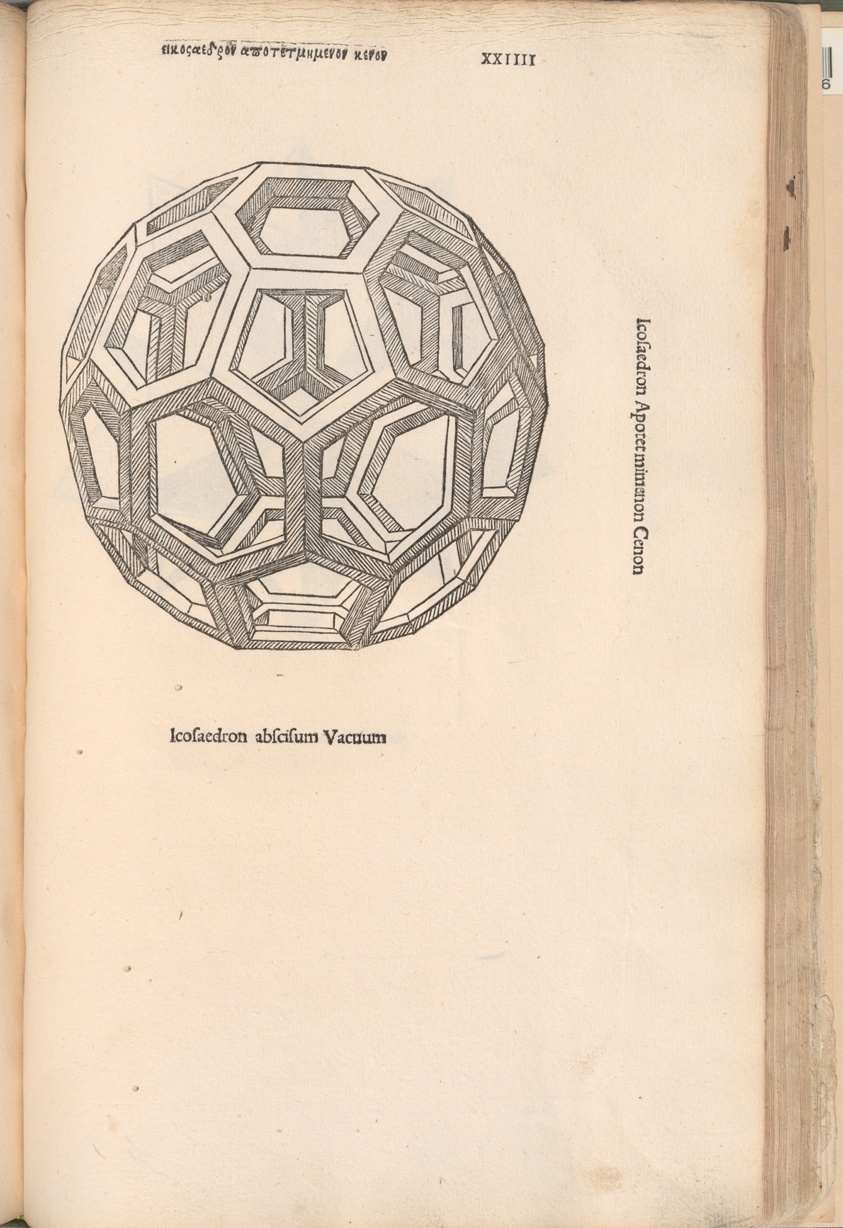
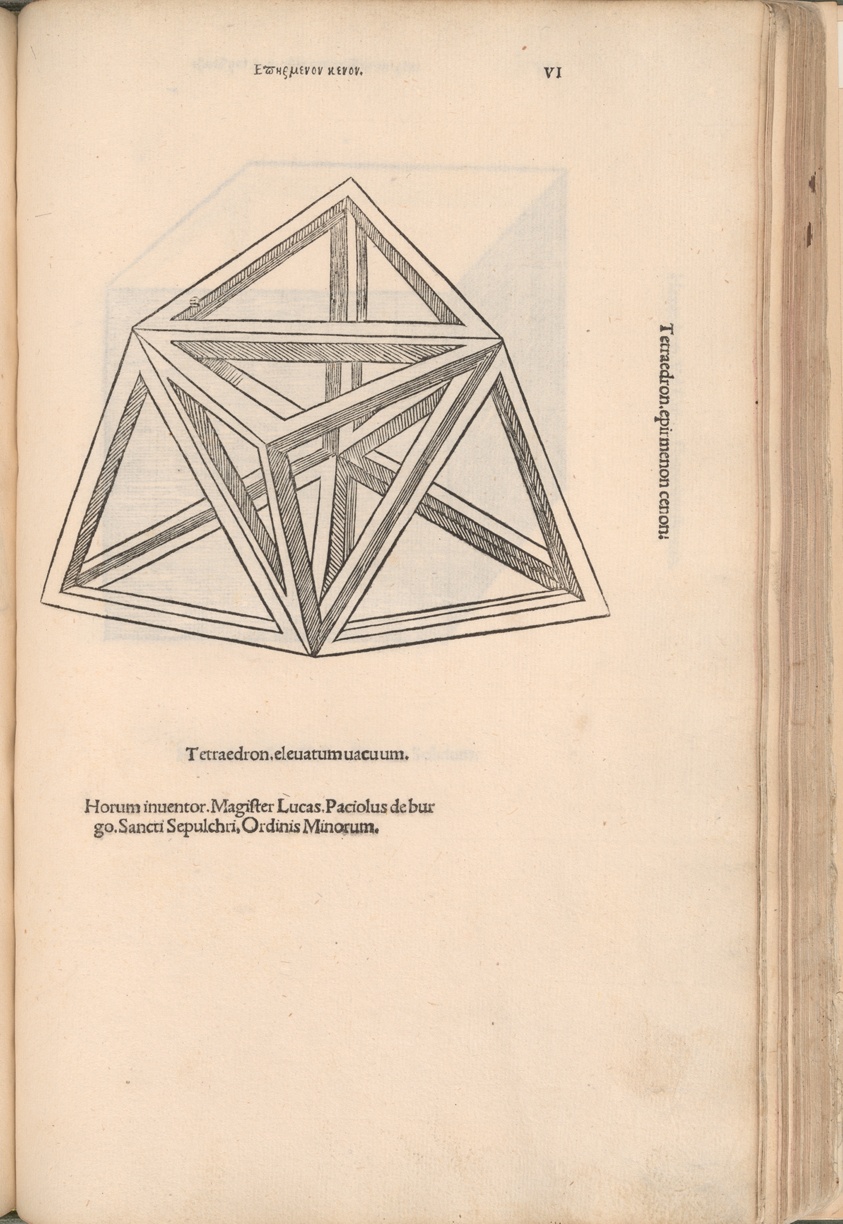
The University of Oklahoma Libraries note that Leonardo provided the geometrical figures in the last section of Luca Pacioli’s book, and that these drawings are the only material of Leonardo’s published in print form during his own lifetime.
Museum record
Leonardo da Vinci; written by Luca Pacioli Divine Proportion, Venice: Paganinus de Paganinus, 1509 Letterpress and woodcut in black with hand lettering in red ink, on ivory laid paper · 29.7 × 20.4 × 3.2 cm The Art Institute of Chicago · Gift of Mr. F.A. Wells · 2024.56
Pacioli wrote the mathematics; Leonardo made the shapes visible, some solid and some hollow, the hollow ones drawn as frames you can see through to their back faces. One is captioned ICOSAEDRON ABSCISUM VACUUM, a hollow truncated icosahedron: twelve pentagons and twenty hexagons, the pattern of a classic football and, since 1985, of the carbon molecule C60. On another page, under a hollow tetrahedron with raised points, the book prints HORUM INVENTOR. MAGISTER LUCAS PACIOLUS, “their inventor, Master Luca Pacioli”. The picture of it, all the same, came from Leonardo.
Habits, not masterpieces
Leonardo is famous for a few paintings. These sheets are famous for nothing in particular, which is what makes them good company: they show an ordinary working day of an unusual mind.
Watch the animal
Try it again
Change your mind
Keep the first attempt
Write it your own way
Make the invisible solid
Next door, in At the Edge of Things, an alchemist’s laboratory from 1595 is lettered DORMIENS VIGILA, “sleeping, keep watch”. Leonardo’s lizard does exactly that.
 This drawing is resting. The museum record remains beside it.