← ARTBITRAGE

A guest room · works shown with the artist’s permission

Anna Vishenskaya · a living painter · Geneva

At the Edge
of Things

幽明

What does a painting see, once you come close enough?

Anna Vishenskaya paints small. Poignant Wonder is smaller than a sheet of A4 paper, and she says the size is the point: the works ask for “an unusual proximity”. So this room is built around one gesture. Each painting first hangs as it would across a gallery, small in a lot of dark. Come closer, stay a little, and it looks back.

幽明, the hidden and the bright. The Book of Changes says that by looking up at the patterns of heaven and down at the order of the earth, one comes to know the reasons of the hidden and the bright: 仰以觀於天文,俯以察於地理,是故知幽明之故 (Xici I ↗; translation mine).

A corridor drawn in code for this room, after Poignant Wonder. It is not her painting; hers is inside.

In the artist’s words

I have created my own universe. It exists at the edge of things, between day and night, between the physical and the unseen, between what we know and what we can only feel.

Their intimate scale demands close attention, compelling the viewer into an unusual proximity. Only at this distance does the image fully reveal itself, returning the gaze as much as it receives it.

Anna Vishenskaya, artistic statement · annavishenskaya.com ↗

Hello, Darkness

I · 影 · Night
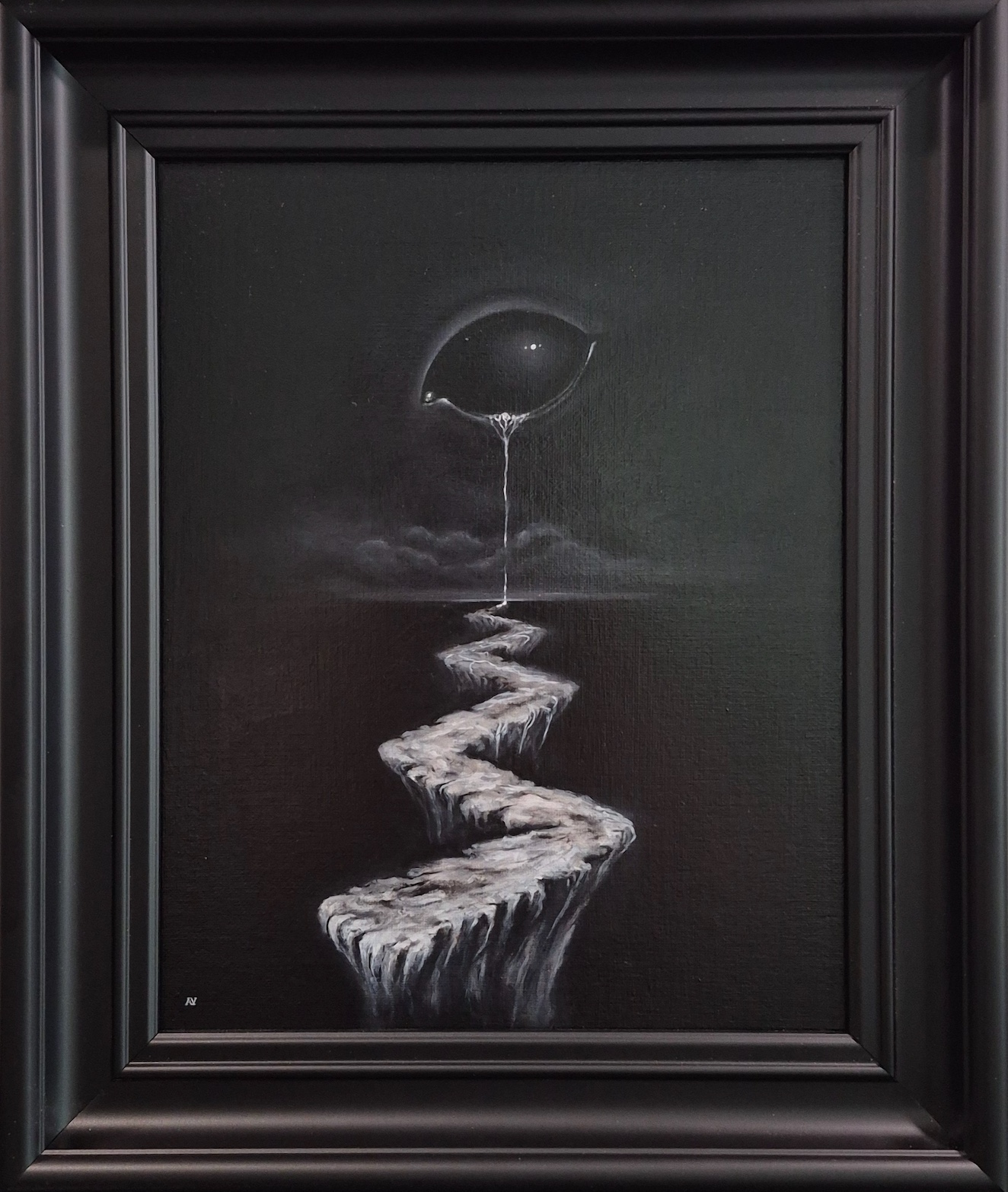
A small painting in a deep black frame. Against a black sky, a dark eye hangs above a low bank of cloud. A single bright thread falls from its lower lid to the horizon, where it becomes a narrow stone path that zigzags toward the viewer, its edges dripping into the dark.
Anna Vishenskaya · Hello, Darkness · 2026 · photographed in its frame

The painting asks backWhat have you been walking away from, that only wanted to be greeted?

In the artist’s words

Hello, Darkness explores the encounter with one’s own shadow. Inspired by Jung’s concept of the shadow, the work is about turning towards the parts of ourselves we fear or reject, rather than escaping them. Darkness here is not evil, but something familiar that asks to be recognised and integrated.

Record

The artist’s listing ↗

A reading

An eye hangs in a black sky, and a single thread of light falls from it to the horizon. Where it lands, it becomes a road. The road does not lead out of the dark; it climbs toward it, ledge by ledge, each edge breaking off into nothing. I read the thread as a tear and as a guide rope at once. The title has the sound of a greeting to an old friend, and her note says the same: darkness here is “something familiar”. You do not say hello to something you are trying to escape.
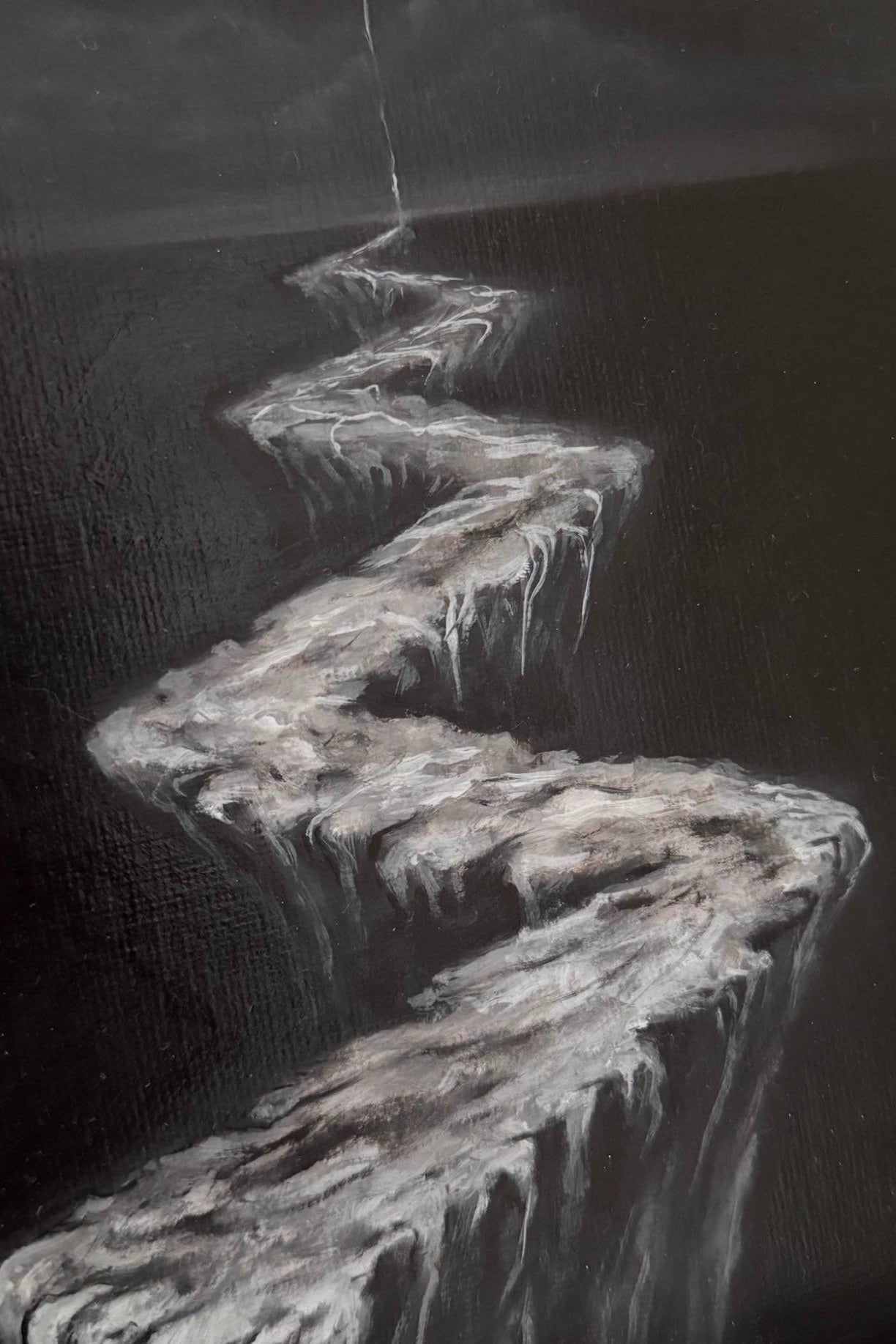
Detail of the path: pale, dry strokes of paint build up the stone, with thin drips hanging from its edges. The fine weave of the canvas board shows through the black around it.
Closer stillThe path, photographed by the artist. At this distance the stone is only paint: dry, pale strokes laid over black, and the weave of the board showing through the night.

Poignant Wonder

II · 初 · Between
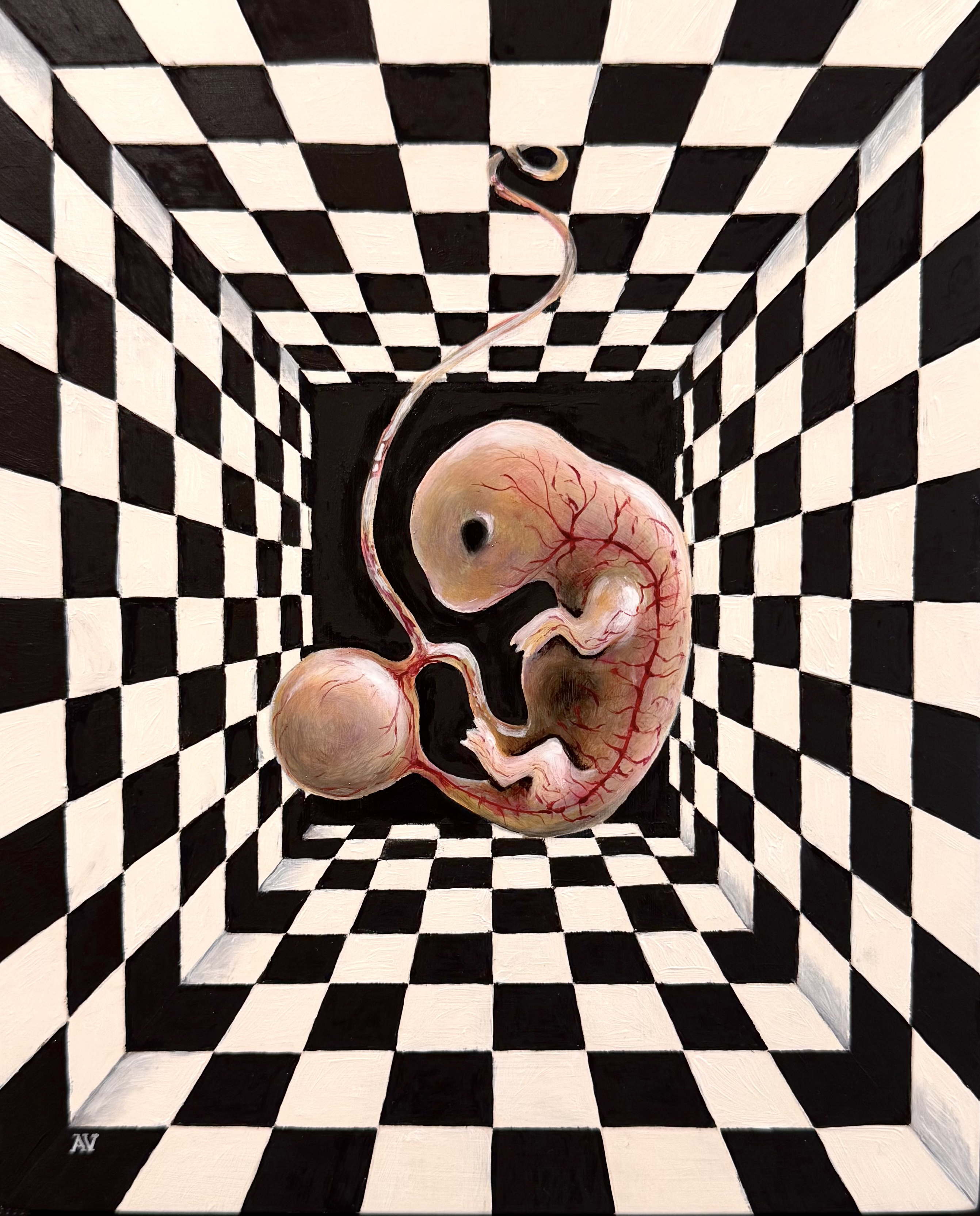
A curled embryo, pale pink and veined with fine red lines, floats in a room whose walls, floor and ceiling are all black-and-white squares receding toward a black opening. Its cord rises and loops in the air; a round sac hangs beside it. Its one dark eye is open. The initials AV sit in the lower left corner.
Anna Vishenskaya · Poignant Wonder · 2026

The painting asks backWhen did you last look at something as if it had only just begun?

In the artist’s words

The artist has published no note for this work. Its title is the only word she has given it, so the reading leans on that.

Record

On the artist’s site ↗

A reading

Every surface of this room is a pattern of hard edges, and every line of it runs toward the black square at the centre, as if the room were a corridor with no end. Inside floats the only soft thing in the picture: an embryo, its cord drifting up and looping into the air, attached to nothing we can see. Its one dark eye is open. Poignant is the word for something that hurts a little because it is precious. Here wonder and vulnerability look like the same thing. The squares could be a chessboard for a game no one has started yet.

Veritas

III · 真 · Day
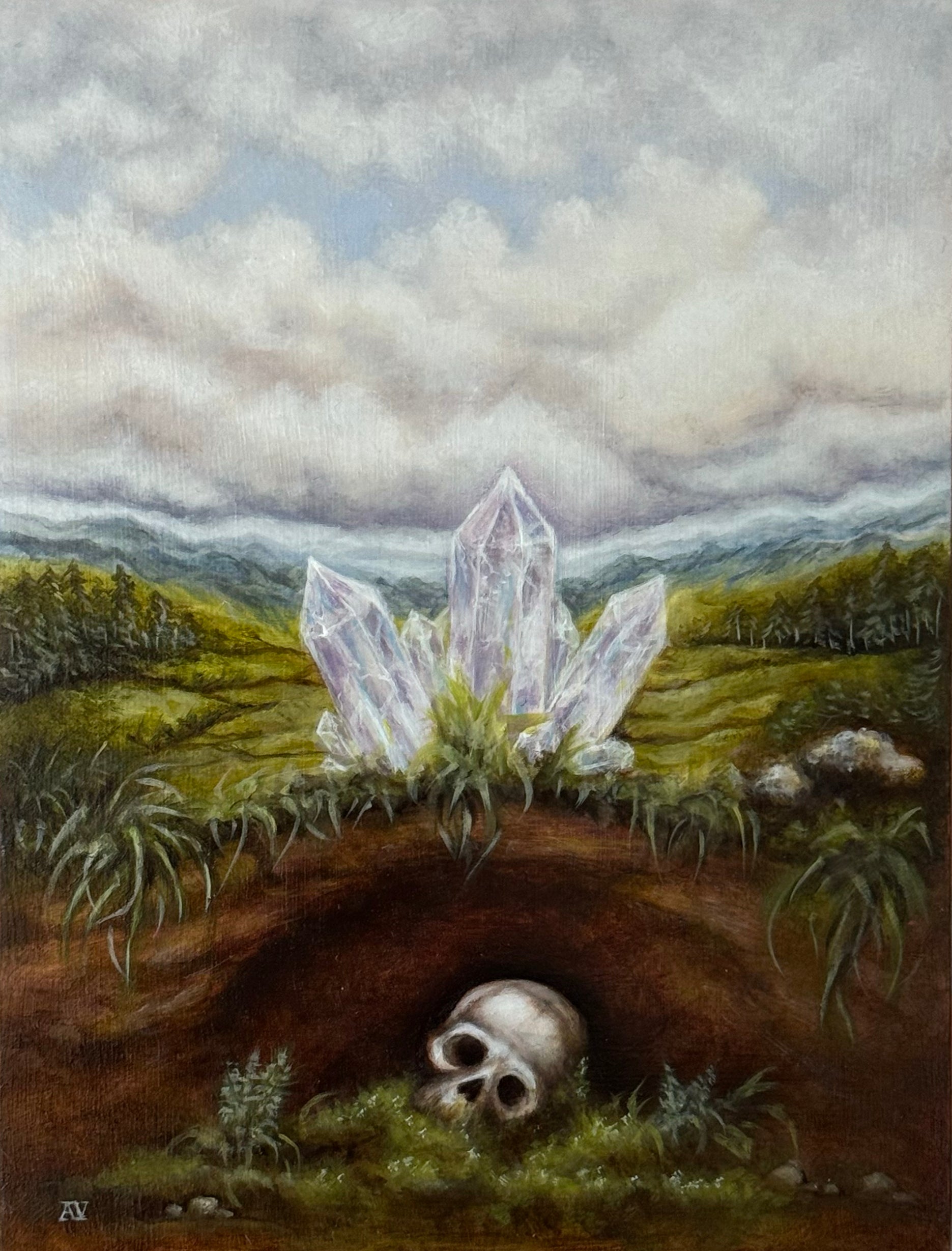
Under a wide sky of soft grey and white clouds, green hills and dark pine forest roll toward distant blue mountains. In the foreground the ground is cut open in section: a hollow of brown earth, and in it a pale skull resting on moss. Above the hollow, a cluster of clear, faintly lilac quartz crystals rises out of a tuft of grass. The initials AV are at the lower left.
Anna Vishenskaya · Veritas · 2026 · the gilt edge here is drawn for the room

The painting asks backWhat do you already know that is still waiting for you to see it?

In the artist’s words

Veritas is about the nature of truth and its tendency to reveal itself. Even when hidden, buried or distorted, truth eventually finds its way to the surface and crystallises into something that can no longer be ignored. The work reflects my interest in truth as a force that exists independently of our willingness to see it.

Record

The artist’s listing ↗

A reading

The sky takes nearly half the panel, overcast and patient. Below, the ground has been opened like a drawing in section, and in the hollow a skull rests on a bed of moss. Between the two, a cluster of quartz has pushed up through the grass. It is the only thing in the landscape with straight edges, and it holds colours the clouds are not giving. Nobody in the picture is digging. Truth here is not uncovered by anyone; it grows, on its own schedule, out of what was buried.

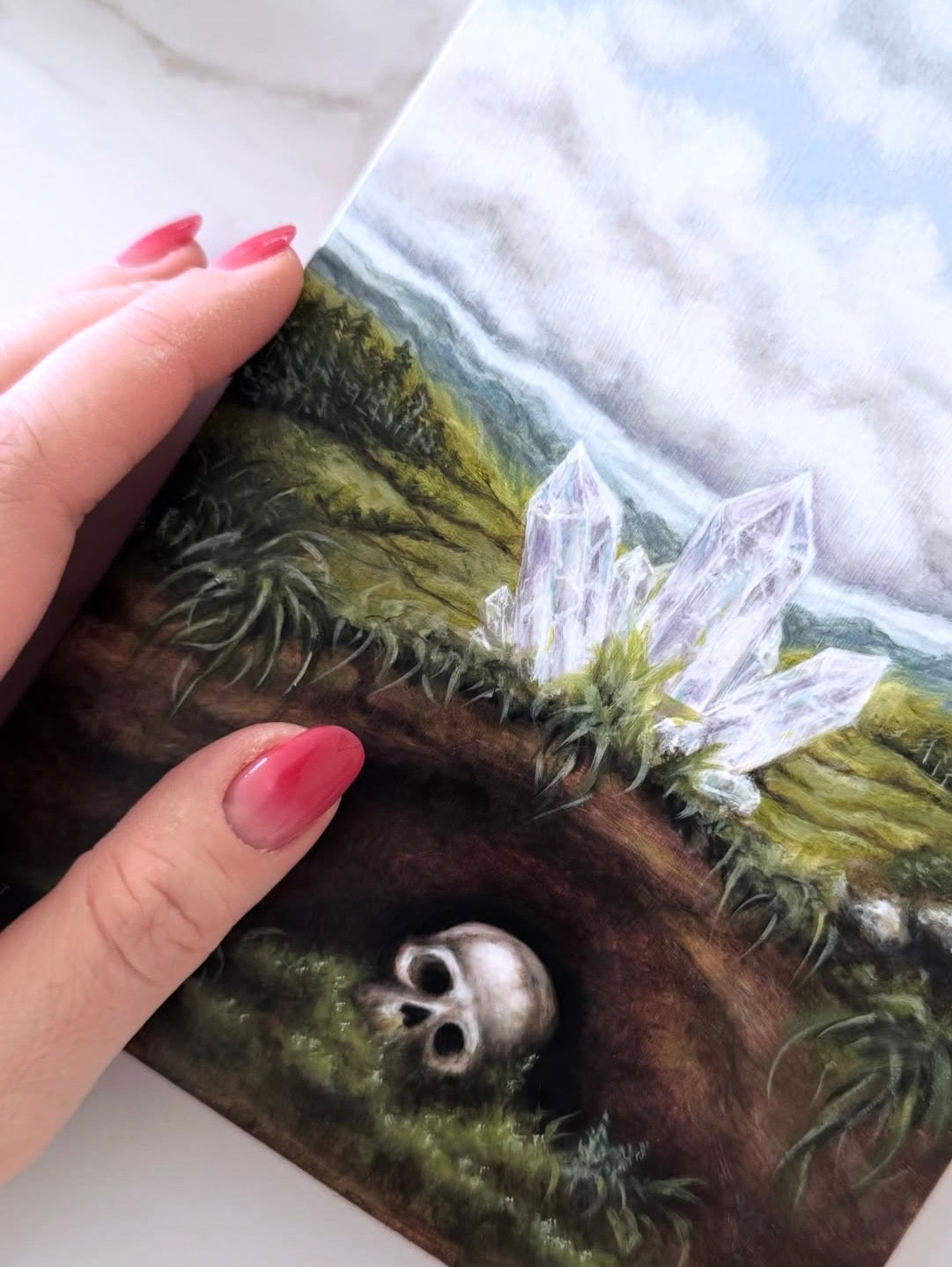
A hand holds the unframed panel of Veritas at an angle over a marble surface; the crystals and the skull in its hollow sit within the span of the fingers.
How big is it, really?A photograph from the artist’s listing. Held in a hand, the panel stops being a picture of a landscape and becomes an object you could carry: the crystals and the buried skull fit within the span of the fingers.

From the open collection · rhymes, not influences

Older rooms, same weather

Most of the paintings in Artbitrage come from the public domain: works by people long gone, released by museums for anyone to use. Beside a living painter, three of them seemed to lean in. These are rhymes for the eye, not claims of influence; nothing here says Anna Vishenskaya studied them.

One thing they do share, by the museums’ own records: each is small enough, or dense enough, to make you step close.

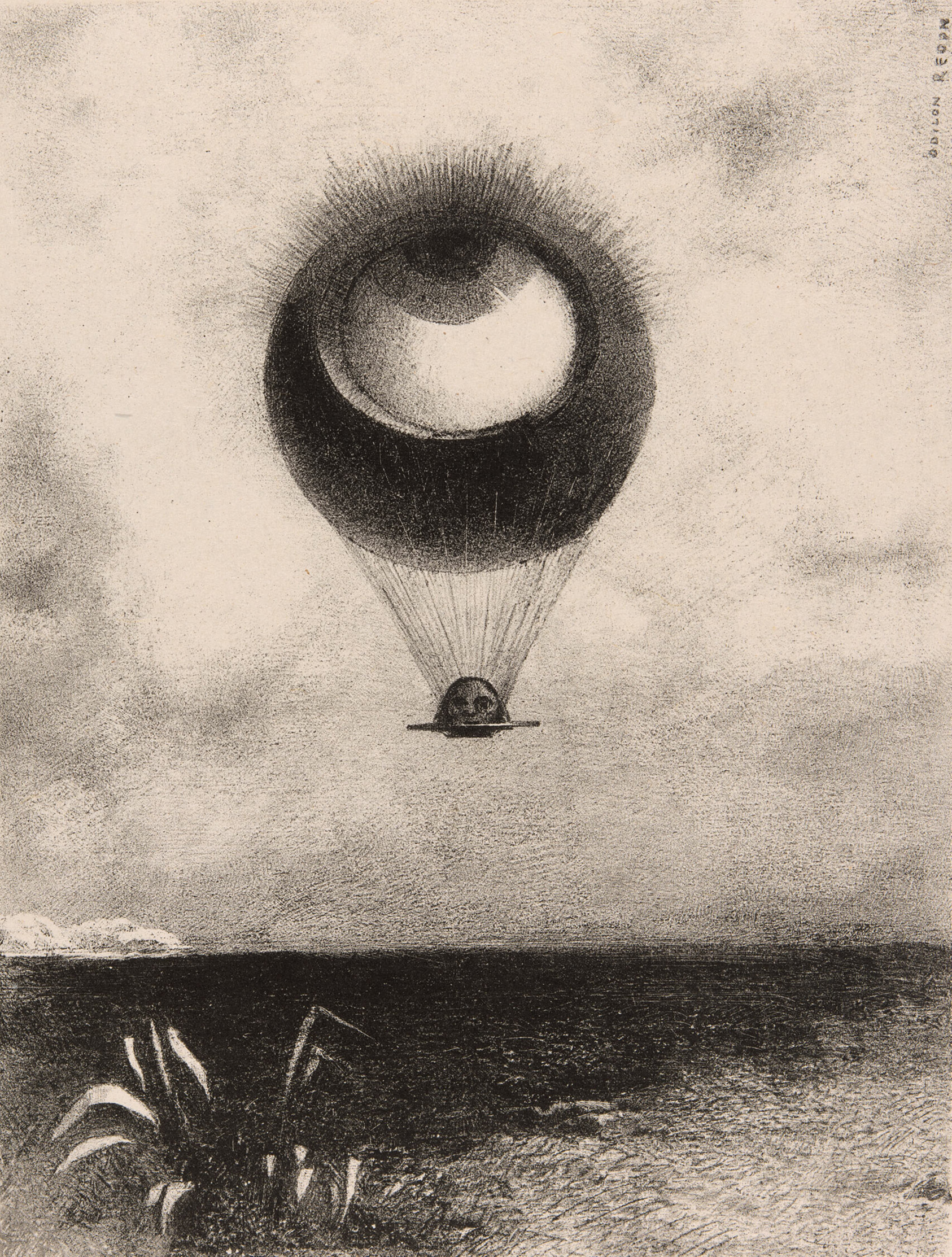
A lithograph in soft greys and blacks. A huge eye, its iris turned upward, forms the envelope of a balloon rising over a dark plain; from its rigging hangs a small dish carrying a head. Spiky plants rise at the lower left.
Public domain · The Art Institute of Chicago

With Hello, Darkness

An eye above the horizon

Redon’s eye is a balloon, rising, with a head carried in its basket; Anna’s eye hangs still and lets a single thread fall. In both, lines run from an eye in the sky down toward the ground, and the dark below is a place you can see into. For about twenty years, from around 1870 to 1890, Redon worked almost entirely in black, in charcoal and lithograph, and called these works his noirs.

Museum record

View the collection record ↗ On the noirs: Getty ↗
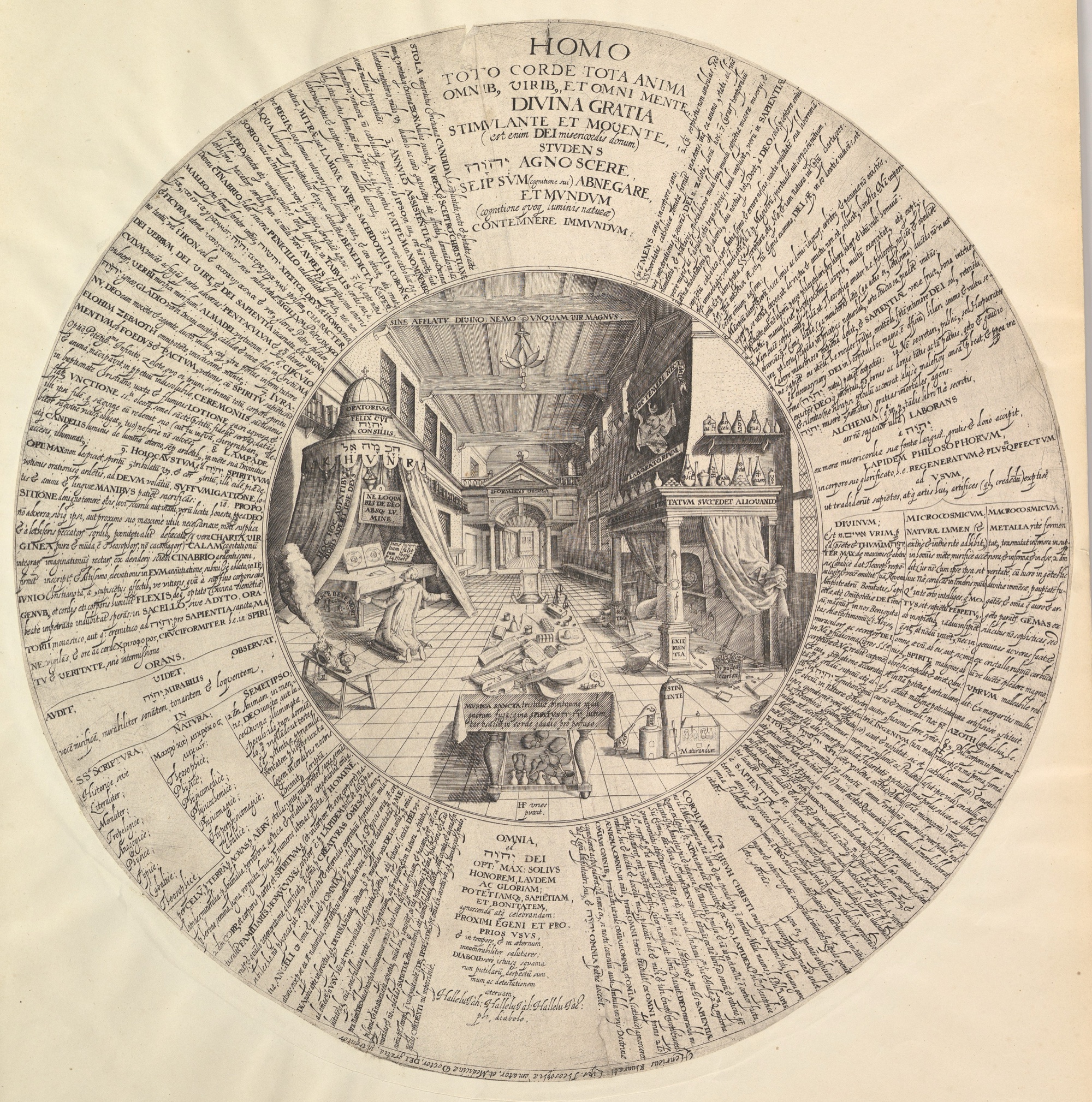
A circular engraving ringed with dense Latin text. At its centre, a long room in steep perspective: on the left a man kneels in prayer at a canopied altar; on the right stand a furnace and shelves of labelled flasks; a table of books and musical instruments runs down the tiled floor toward a far doorway.
Public domain · The Metropolitan Museum of Art

With Poignant Wonder

A room for slow change

Another room built on strict perspective, its tiled floor running toward a far door. The plate labels its two halves: ORATORIVM on the left, where a man kneels in prayer, and LABORATORIVM on the right, with its furnaces and flasks. Prayer and work share one floor. Look closer and there is more lettering: over the far doorway, DORMIENS VIGILA, roughly “sleeping, keep watch”; on the furnace in front, FESTINA LENTE, “make haste slowly”. C. G. Jung would later read alchemical pictures like this as maps of inner change (Psychology and Alchemy, 1944). Beside Poignant Wonder, both rooms ask the same thing: what kind of space does a beginning need?

Museum record

View the collection record ↗ The 1595 edition: UW–Madison ↗
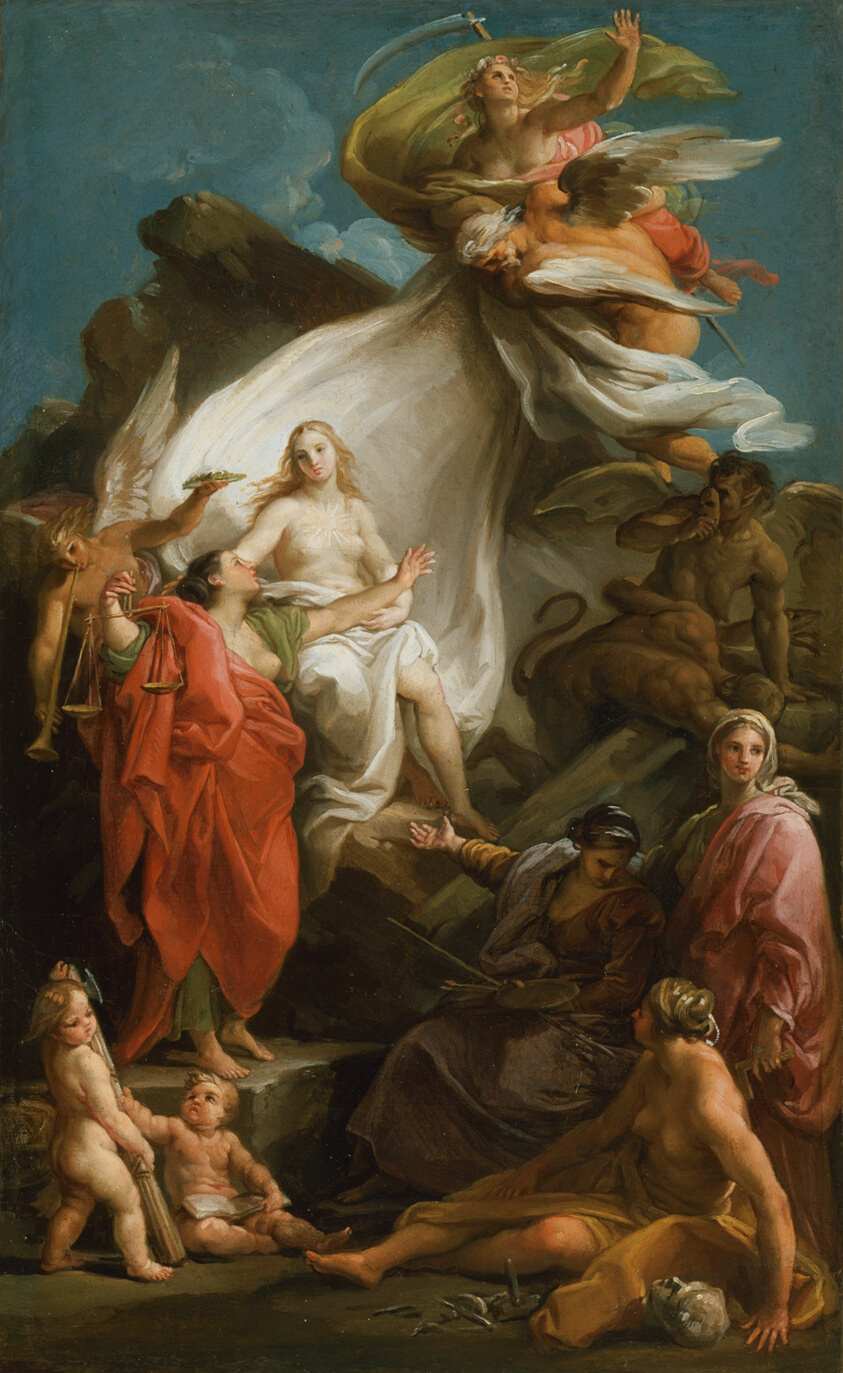
A small, sketch-like oil painting. Near the top, a winged figure with a scythe sweeps a great pale drape aside. Below, a fair-haired figure, half-draped in white, sits on a rock with a radiant sun on her breast; a woman in red beside her holds a pair of scales. Dark figures lurk at the right, and women with the tools of the arts sit in the foreground.
Public domain · The Art Institute of Chicago

With Veritas

Truth, given time

An old Latin saying stands behind pictures like this: truth is the daughter of time. Aulus Gellius, writing in the second century, remembered it from “one of the old poets” whose name he had forgotten. In Batoni’s small oil, which the museum thinks was probably a preparatory sketch, Father Time pulls the drapery away and Truth shines with the sun on her breast, while Envy and Discord lurk in the shadow. Batoni needs someone to do the unveiling. In Veritas, nobody does: the crystal comes up by itself.

Museum record

View the collection record ↗ Gellius, Attic Nights 12.11 ↗

How a panel is made · 慢

Light arrived at, not applied

Working primarily in oil on traditional wooden panels, I have developed a slow, layered process inspired by medieval painting techniques. Each work unfolds gradually over weeks or months, allowing the image to reveal itself in its own time.Anna Vishenskaya, artistic statement

Veritas is painted on a “traditional gessoed icon board”. In one method of the icon tradition, as the Icon Museum and Study Center describes it, the wood is cut to size and given a shallow recess, the kovcheg, Russian for “ark”. Linen is glued to the surface, and several layers of gesso, a mixture of chalk, marble dust, water and glue, go on top. Dried and polished, the board becomes “hard but absorbent”.

In the same tradition, icons are painted in egg tempera, starting from dark base layers and building up through layers of increasingly bright pigment. Anna paints in oil, and calls her process her own, refined through continuous experimentation. So the drawing here shows the board’s traditional anatomy, not her studio steps.

Source: “Creation of an Icon”, the Icon Museum and Study Center ↗, describing the Prosopon School’s method, “just one of many ways to create an icon”.

The layers of a traditional icon board A cross-section, bottom to top: a thick wooden board; a thin sheet of glued linen; several thin white layers of gesso, polished smooth; then painted layers that move from dark to light. Labels sit to the right of each layer. woodcut to size; a shallow recess linen, glued down gesso, several layerschalk, marble dust, water, glue paint, dark to lightbuilt up over time LIGHT ↑ NOT TO SCALE
A schematic drawn for this room from the source on the left. Layer thicknesses are not to scale.

Her process and her Veritas say one sentence twice: given time, things come up through the layers.

Visit the artist

Anna Vishenskaya

Anna Vishenskaya (b. 1987) is a painter based in Geneva who works mainly in oil on traditional wooden icon panels. She holds a degree in psychology, names Jungian thought and “the symbolic language of humanity” as deep influences, and has painted full time since 2025. Her paintings, she writes, “begin with inner visions, dreams and movements of the subconscious”. Her work is held in private collections in Switzerland, the United Kingdom and the United States.

Her works emerge slowly, a layer at a time, and some begin in dreams: her own, and sometimes dreams that others have brought to her to paint.

2026, from the artist’s site

  • ArtEvol: A View from Everywhere, London Art Collective · shortlisted, included in the exhibition catalogue
  • Beautiful Bizarre Art Prize · longlisted, BearWolf Books Emerging Artist Award
  • Arts to Hearts × Artsy Small Works · finalist (Top 54)
  • Lucid Dreams, Ten Moir Gallery · finalist
  • Arteporté Summer Exhibition and Arteporté Surrealism IV · international group exhibitions, Turin
  • MEDUSA, LA GORGONE · international group exhibition, Livorno
  • DREAMS: An Art Book of the Inner Night · selected publication, Barbagelata Contemporary Art Foundation