ARTBITRAGE Behind the work

Making · meaning · keeping

A world goes
into a work.

Before a picture reaches us, there are hands, tools, experiments, materials, and decisions. After it is made, the care continues.

Look a little longer. The image can open onto a workshop, a mountain, a trade route, a place of worship—or a conservation studio.

Meet the hands behind the wave
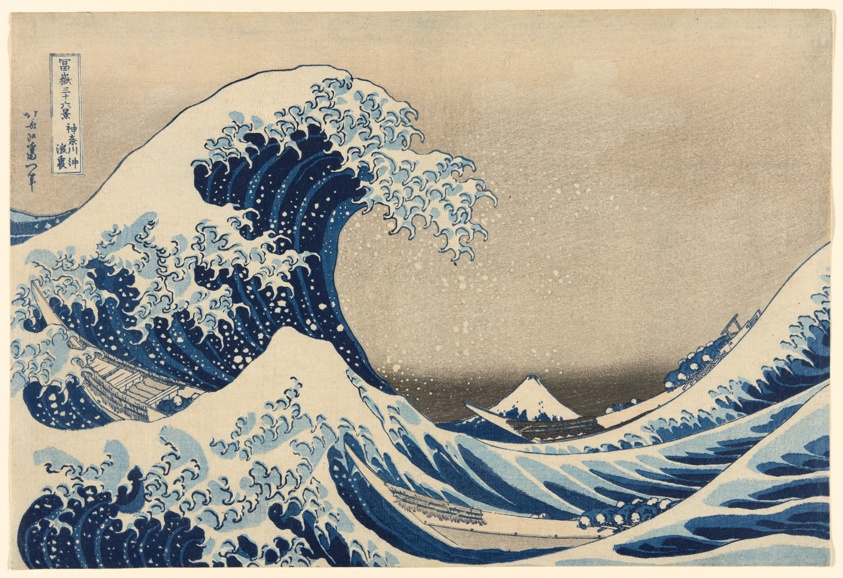
A blue wave curls above three boats, with Mount Fuji small beyond it.
The Great WaveKatsushika Hokusai · 1830/33 · colour woodblock printArt Institute of Chicago · CC0 ↗

01 / The work behind the image

One signature.
Many hands.

Hokusai supplied a design. Turning it into a colour print depended on the knowledge of other people: carving, mixing, aligning, printing, and bringing an edition to market.

  1. The artist

    A drawing establishes the design that the workshop will translate into wood.

  2. The carvers

    Wood is cut away to leave raised lines and areas that will carry the colour.

  3. The printers

    Colour, pressure and alignment are handled across successive impressions from the blocks.

  4. The publisher

    The edition is commissioned and sold. A market helps shape which images circulate.

On the workshop and its skills: British Museum · Making a good impression ↗

A wave with a trade route

Even its blue travelled.

Prussian blue, a manufactured pigment developed in Europe, reached Japan through trade with China and the Netherlands. The Great Wave’s colour belongs to a history of chemical invention and exchange, as well as to Hokusai’s imagination.

British Museum · Editions, colour and block wear ↗

Prints made from the same design differ. The Art Institute identifies its impressions as later than the first state; findings about another museum’s sheet are not automatically findings about this one.

Art Institute · About this impression ↗
Look at the wave again
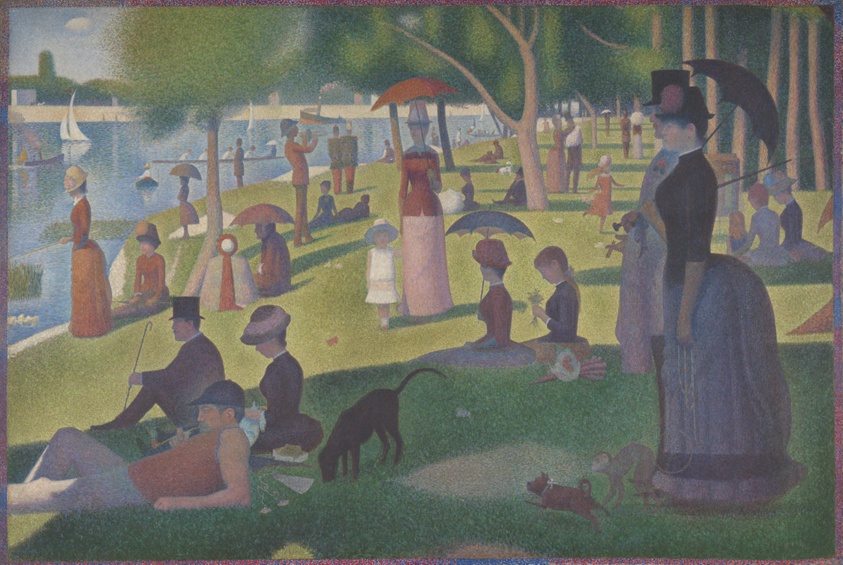
Figures, parasols, trees and boats are built from many small touches of colour on Seurat’s riverbank.
A Sunday on La Grande Jatte — 1884Georges Seurat · 1884–86; border added 1888–89Art Institute of Chicago · CC0 ↗

Time, knowledge, revision

An afternoon that
took years.

Seurat prepared this scene through numerous drawings and painted studies, and returned to change it. The ease of an afternoon by the river holds a long process of looking, planning and revision.

The museum’s account of its making ↗

The materials have a life, too.

Art Institute researchers identified zinc yellow that had darkened towards brown—even during Seurat’s lifetime. A colour placed beside another colour can change the whole effect as it ages.

The museum’s conservation account describes protective glazing for the unvarnished painting. Behind our moment of looking is another kind of work: studying change and slowing further damage.

Art Institute · Microscopy and changing colour ↗

When you look again, can you see both the afternoon and the time it took?

Return to the riverbank

02 / A colour is also a material

Mountains. Insects.
Factories.

Colour connects nature to human skill—and human skill to money, belief and power. Follow three material histories, across painting and textiles.

Natural ultramarine · a pigment

A mountain in
a sacred blue.

Natural ultramarine was extracted from lapis lazuli mined in Afghanistan. Obtaining and processing the stone made the finest grades exceptionally expensive; patrons could specify how much was to be used.

In European devotional painting, its preciousness helped make it a colour for the Virgin Mary’s robes. A painted blue could carry the cost of a journey, a patron’s resources, and an act of devotion.

Who could afford this colour—and what did choosing it say?

National Gallery · Ultramarine, cost and devotion ↗
Cochineal · a source of dye and pigment

A small insect.
A vast trade.

Cochineal colour comes from insects that live on cacti. The red in an artwork or a textile can begin with a living organism and the knowledge needed to turn it into colour.

The Met · Where cochineal colour comes from ↗

Under Spanish colonial rule, cochineal and indigo were among the valuable dyestuffs exported from the Americas. Their circulation belonged to an economy of empire, alongside the skilled work of textile makers.

When colour becomes wealth, who does the work—and who receives the value?

The Met · Textile trade, colonial power and religion ↗

Mauveine · a synthetic textile dye

Colour enters
the factory.

In 1856, William Henry Perkin’s experiments with aniline derived from coal tar led to mauveine. Turning that discovery into a commercial dye involved patents and manufacturing, and helped establish the modern chemical industry.

The Science and Industry Museum preserves his notebooks, patents and dye samples. These records let researchers study how production changed beyond the original recipe.

What changes when a colour can be manufactured at scale?

Science and Industry Museum · Perkin’s dye and industry ↗

The swatches are screen approximations. These are wider material histories, not pigment identifications for the artworks shown here. Pigments and dyes behave differently; a colour on a screen cannot tell us what a work is made from.

Open the pigment reference room

03 / A form made from the earth

Clay. Heat.
Judgement.

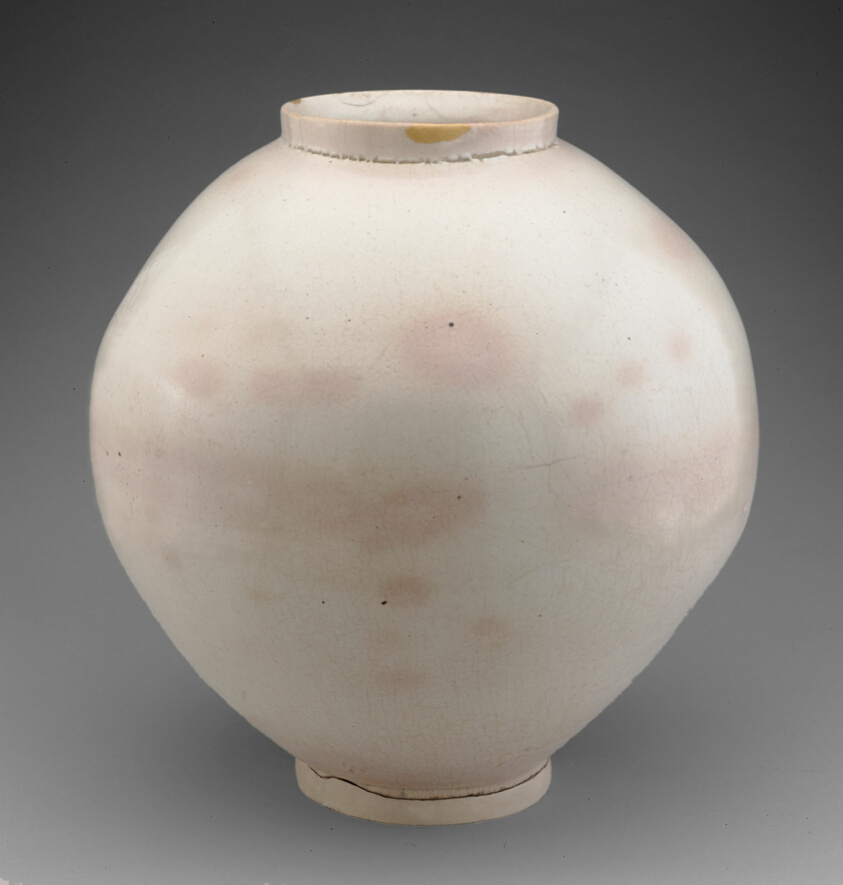
This moon jar was formed from two hemispherical halves joined together. The meeting leaves a subtle flattening around its middle. What appears to be a simple rounded form holds a demanding act of construction.

Art Institute · How this moon jar was made ↗

White porcelain requires high firing. In the wider Joseon porcelain industry, court-managed kilns organised production for royal use. The Met connects early Joseon elites’ preference for plain white ware partly to Neo-Confucian ideals, while also noting practical and economic influences.

The Met · White porcelain, court kilns and belief ↗

That is the wider history of Joseon porcelain, not proof that this particular jar came from a court kiln.

Follow its uneven curve. What changes when you imagine the making?

Return to the quiet form
A rounded Korean white porcelain jar, slightly uneven at the middle, with marks on its glazed surface.
Moon JarKorea · Joseon dynasty · late 17th–mid-18th centuryArt Institute of Chicago · CC0 ↗

04 / The work of keeping

Making ends.
Care continues.

A work does not simply arrive in a museum and stay unchanged. Preserving it takes observation, research, skilled handling, resources and decisions—often repeated across generations.

What would you need to know
before changing a work?

A mark might be a trace of making, a later change, or damage. The Art Institute offers two possible explanations for spots on its moon jar: residues from earlier contents, or crystals formed as the kiln cooled. The uncertainty is part of what we know.

Read the museum’s description of the marks ↗

Care begins with paying attention.

01 Protect before treatment

Light, moisture, pollutants and physical shocks can change materials. Managing display, storage and transport helps reduce damage before a repair becomes necessary. Much of this work stays out of sight.

Getty · Preventive conservation and collections care ↗
02 Look beneath what is visible

Conservators and scientists combine examination, records and material analysis. At the Art Institute, microscopic study helped explain the changing yellow in Seurat’s painting. An image alone could not establish that chemistry.

Art Institute · What microscopy can reveal ↗
03 Weigh what a repair changes

Strengthening a painting can affect its surface and original materials. In a study of modern canvas treatments published by Getty, conservators weigh stability, appearance and the consequences of past interventions. Leaving future options open is part of the judgement.

A repair involves deciding what to retain, what to change, and what evidence might be lost.

Getty · Decisions in the structural treatment of canvas ↗
04 Keep watching, keep learning

At the National Gallery, care ranges from regular condition checks to controlling light, temperature and humidity. Conservation is continuing work, supported by scientific and curatorial study. Preservation has an ongoing cost in time, attention and expertise.

National Gallery · Caring for the paintings ↗

Back to looking

The picture is still here.
What else do you see?

The maker’s decisions. The material’s journey. The people who kept it.
Appreciation can hold all of these, alongside the feeling.

Return to the gallery ↗Follow a work into its history ↗