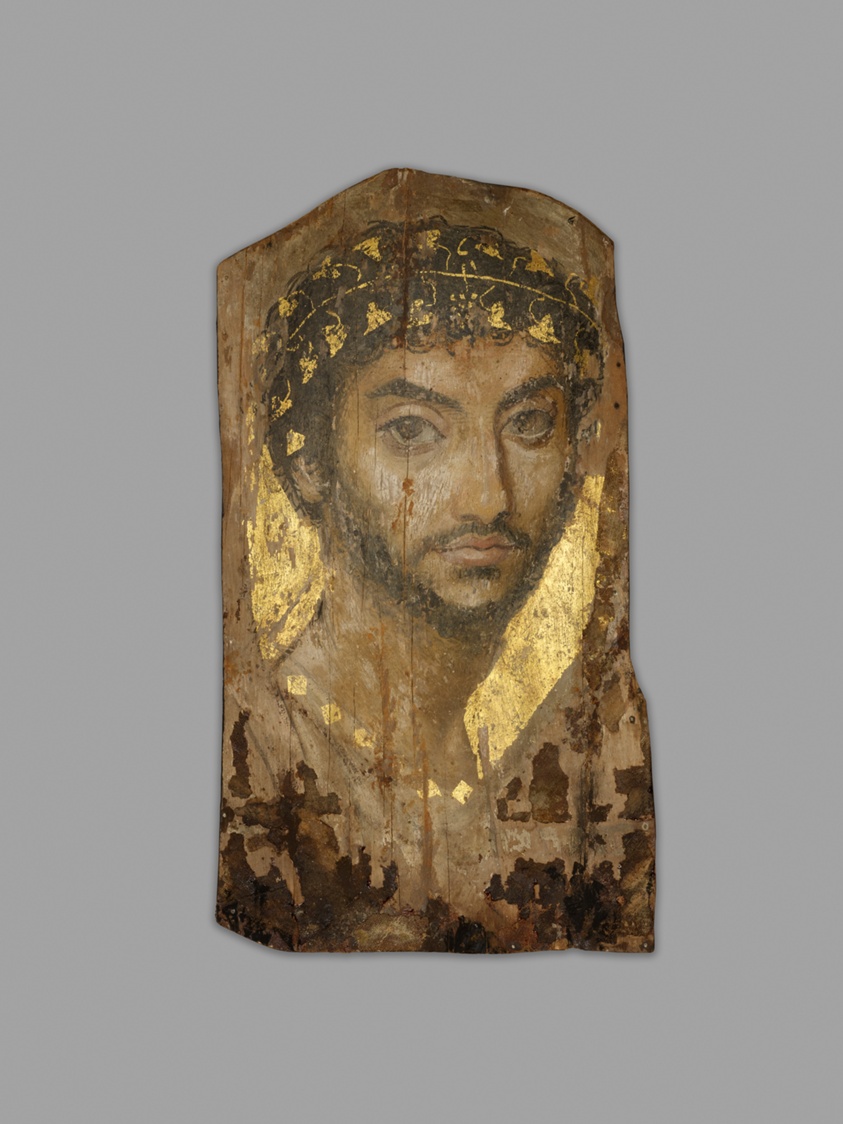
Portrait of a Man Wearing an Ivy Wreath
- Maker
- the record does not name the maker
- Recorded as
- Egyptian; The Fayum, Egypt
- The record keeps
- Probably the Fayum, Egypt · Roman period, early to mid-2nd century · wax and pigment on linden wood, with gold
01A face, kept
What I notice
Someone looked at him for a long time.
He looks straight out, eyes wide and level, as if you had just said his name. You can’t, though. Nobody can. The record keeps the wood, the wax, the gold and the century. It keeps neither the man nor the painter.
What survives is the looking: the curls laid in one by one, the gold leaves in his hair, the shadow under his lower lip. Someone stood close to this face and decided it was worth keeping.
Look for
- Find the small gold squares along the neckline of his garment. How many can you count?
- Follow the thin gold band around his hair and look at the small leaves hanging from it. What shape are they?
From the museum
Roman Period, early to mid–2nd century · Lime (linden) wood, beeswax, pigments, gold, textile, and natural resin
Portraits like this were painted on thin wood and laid over the face of a mummified person, held in place with linen. The museum notes that this panel was trimmed at the top to fit, and that resin and wrappings still cling to it. Scholars disagree about which plant the gold wreath shows.
This portrait was made for a burial. I’ve tried to meet it as a person’s face, not as a curiosity.
Provenance Given to the museum in 1922 by Emily Crane Chadbourne. Where it was found, and how it left Egypt, are not recorded.
See the museum record