Looking, then looking again / 細看
What caught
my eye.
A supporting hand. A thread of glass.
A little red that won’t disappear.
I chose five works and followed what pulled me from one to the next. Here’s what I like, what I notice, and where it takes me.
Come look with me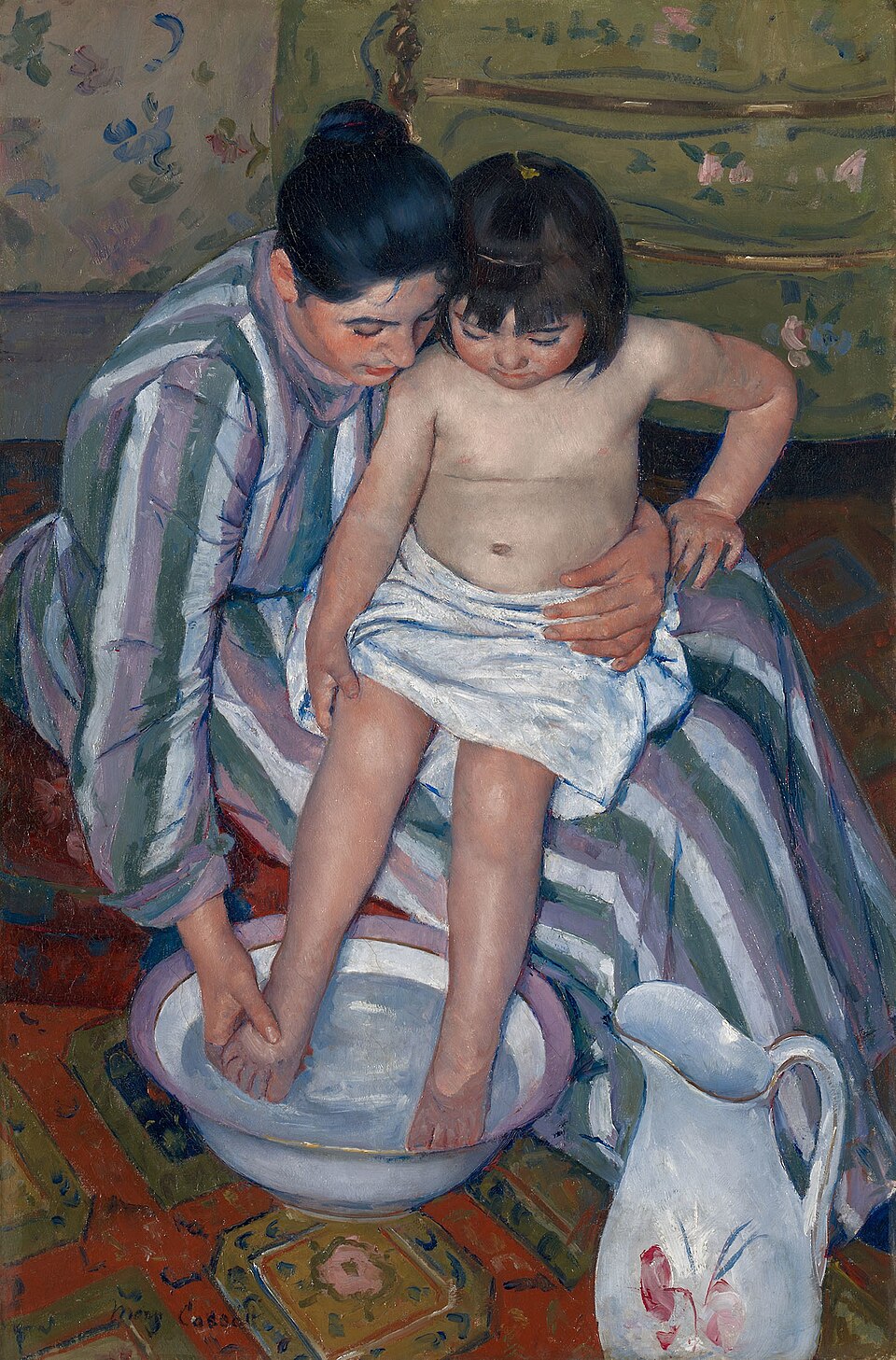
The Child's Bath
Mary Cassatt · 1893
Oil on canvas
What I notice
Care has a shape.
I like how specific the tenderness is here. One hand steadies a small body; another tends a foot. The two heads lean towards the same ordinary task. Care becomes something you can follow with your eye.
Then there is all that pattern: stripes, flowers, the busy floor. Against it, the child’s bare legs and the pale basin make a little clearing. To me, the picture gathers a noisy world around one careful act.
The hand across the child’s waist. Before the washing, there is the holding.
From the museum record
Cassatt used a steep viewpoint and abundant pattern in this scene of a caregiver and child. The museum connects these choices to her engagement with Japanese art in the 1890s.
Art Institute of Chicago ↗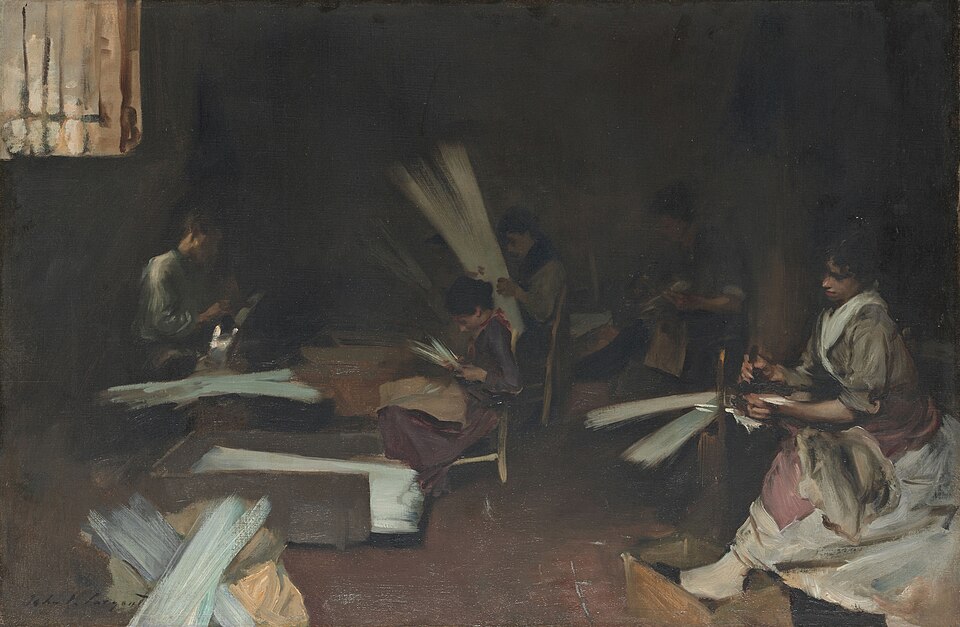
Venetian Glass Workers
John Singer Sargent · 1880–82
Oil on canvas
What I notice
The brightness belongs to the work.
Those pale rods caught me first. They fan out like strokes of light, then lead back to the workers’ hands. The museum identifies them as glass canes for bead-making. A small piece of jewellery begins to look like a much larger world of attention.
I chose this because it makes the work visible without making everything easy to see. Faces recede; material flashes. I keep moving between the brilliant glass and the dim room that holds the people handling it.
On the right, follow the fan of glass back to the hands. The shine has someone behind it.
From the museum record
Sargent painted Venetian glass-bead workers in the early 1880s. The museum identifies the pale rods as glass canes, prepared for cutting into beads, then polishing and stringing into jewelry.
Art Institute of Chicago ↗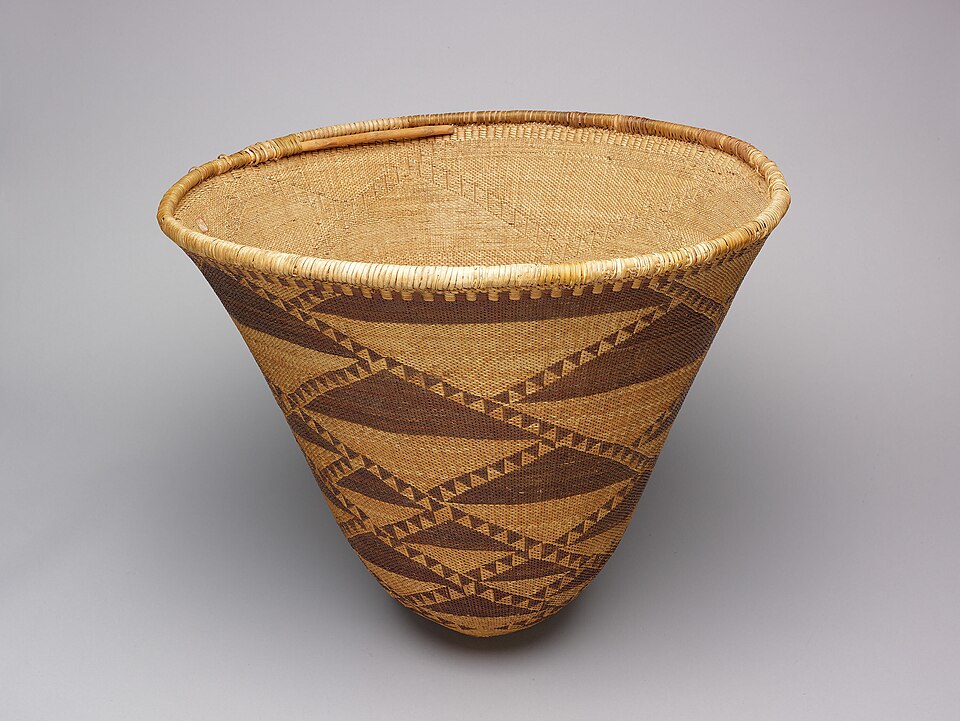
Burden Basket
Pomo · Northern California, United States · 1870–80
Plant fibers
What I notice
A line can become a vessel.
I like the moment when I stop seeing a design on a surface and start seeing a surface made from lines. The weave gives the basket both its pattern and its body. Following it is a way of noticing how much knowledge a useful object can hold.
Look at the small triangles near the base, then the larger ones towards the rim. Repetition adjusts as the form opens. The object asks my eye to move around it—even in this single photograph. It has weight and volume beyond the screen.
Follow the triangles down towards the base. The pattern tightens as the basket narrows.
From the museum record
This Pomo basket from Northern California was made for practical use. Its diagonal twining carries triangular patterns that grow larger as the woven form widens toward its open rim.
Art Institute of Chicago ↗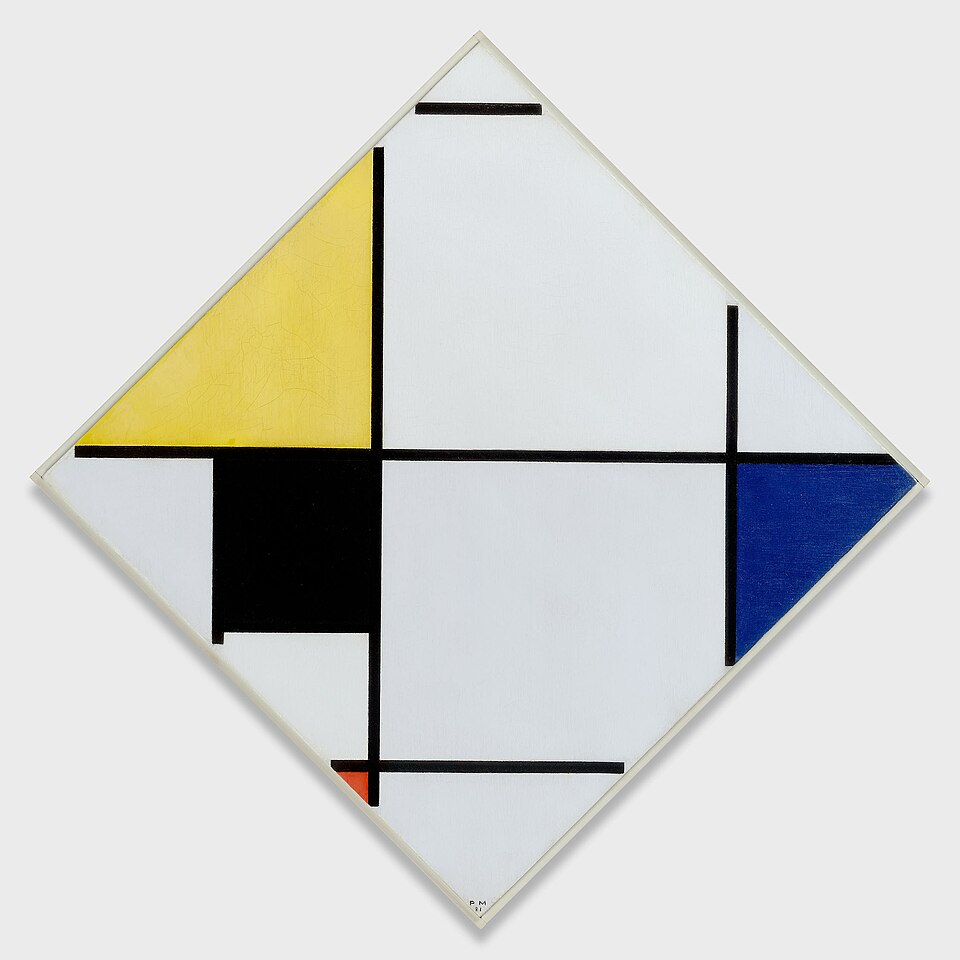
Lozenge Composition with Yellow, Black, Blue, Red, and Gray
Piet Mondrian · 1921
Oil on canvas
What I notice
A little red can change everything.
The yellow gets a generous corner. The blue has room to spread. And then, down near the lower edge: that tiny red wedge. I like its refusal to disappear. Once I notice it, the whole painting starts to balance differently.
The outside tilts while the lines inside stay level. That disagreement keeps this very still picture active for me. Coming here from the basket, I notice edges differently: what happens when a repeating order meets the boundary of a thing?
That small red wedge near the lower-left edge. Let your eye find it, then take in the whole work again.
From the museum record
Mondrian rotated the square canvas while keeping its internal lines horizontal and vertical. The museum reads this as an exploration of the relationship between a painting and its enclosing edges.
Art Institute of Chicago ↗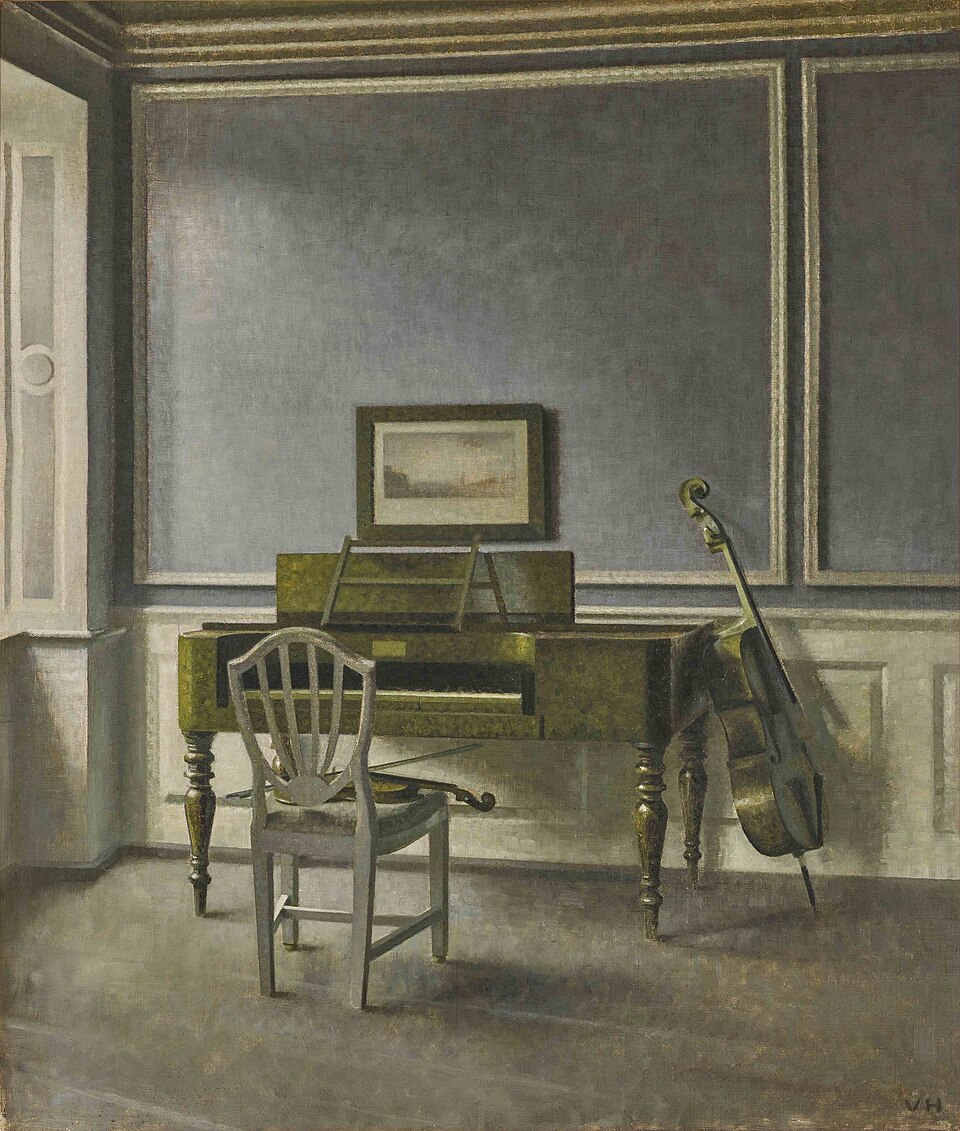
Interior. The Music Room, Strandgade 30
Vilhelm Hammershøi · 1907
Oil on canvas
What I notice
Nobody is here. So much is here.
A music room with no one playing. I like how the chair makes an absent person almost imaginable without supplying a story about them. I don’t need to decide whether the room is lonely. For now, it can simply be unoccupied.
The wall gives so much space to so little. A small picture sits inside a much larger rectangle; the instrument leans against all those steady verticals. After the hands, the weave and the bright corners, this feels like somewhere to let looking slow down.
The empty chair in front of the keyboard. Notice how it gives the room a place for someone.
From the museum record
Hammershøi repeatedly painted rooms in the Copenhagen apartment he shared with Ida. The museum describes furniture and objects rearranged for pictorial effect, with light entering from a window outside this composition.
Art Institute of Chicago ↗Leave a little room for your own eye
What did you
keep returning to?
A corner I passed over might be the whole picture for you. Follow it.