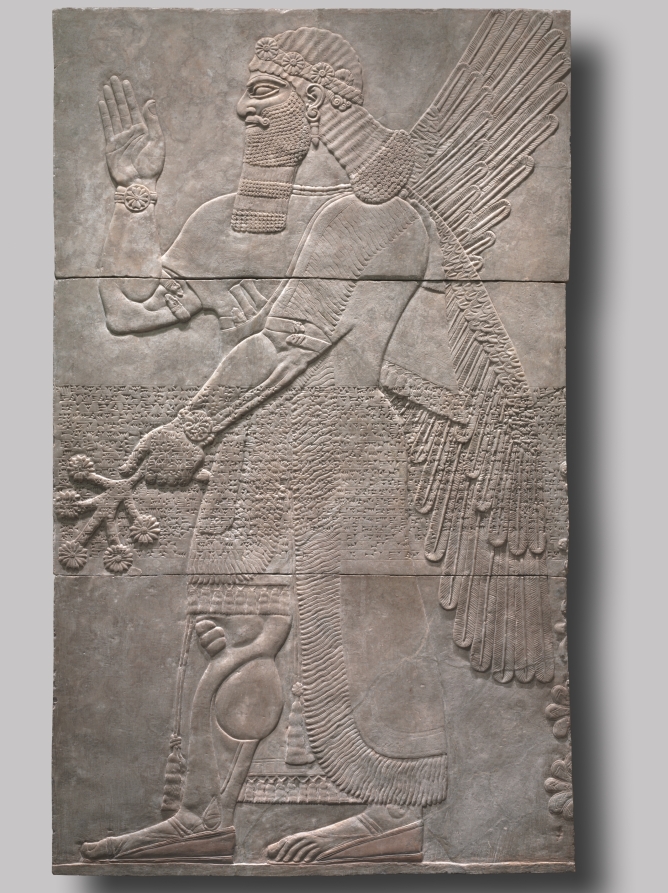
Writing was born counting. Around 3300 BCE, in the city of Uruk in southern Mesopotamia, temple accountants began keeping records in wet clay — and the overwhelming majority of the earliest tablets are exactly that, accounts: barley, beer, sheep, rations. Scholars still debate how counting-tokens and tallies hardened into those first pictographs, but the decisive leap is clear: the rebus principle, borrowing a picture for its sound — draw an arrow, Sumerian ti, and you have written the like-sounding word for "life." Over the following centuries the drawn line gave way to the pressed reed, whose tip leaves a wedge (Latin cuneus — hence cuneiform). Some 2,400 years later, on this gypsum relief from Ashurnasirpal II's Northwest Palace at Nimrud (883–859 BCE), a band of cuneiform recounting the king's military conquests runs straight across the winged spirit's body: the text defers to nothing, not even a god. Bookkeeping had become history.
文字生於算帳。公元前三千三百年前後,兩河下游的烏魯克城,神廟的記帳人開始在濕泥板上記事——最早的泥板,十之八九是帳:大麥、啤酒、羊、口糧。籌碼與刻痕如何蛻變為最初的圖形符號,學界至今仍有爭論;但關鍵的一躍很清楚——借形記音:畫一支箭(蘇美語 ti),便寫下了同音的「命」。其後數百年,描畫讓位於按壓,蘆葦筆尖按入泥面,一筆成楔,「楔形文字」由此得名。約兩千四百年後,在尼姆魯德西北宮的這方石膏浮雕上(公元前883–859年),整條銘文橫貫翼神身軀,記的是亞述王亞述納西爾帕二世的征伐——文字面前,連神也要讓路。帳,終於長成了史。
Stand at the middle band: the carvers ran the king's text straight over feathers, muscle, and fringed cloak, wedge cut into wing without pausing. The same account of conquest was repeated, nearly verbatim, on slab after slab of the palace — Assyriologists call it Ashurnasirpal II's Standard Inscription — a drumbeat addressed as much to the gods and to posterity as to any living reader. And notice what a wedge is: not drawn but pressed — the broad head where the stylus (here, a chisel imitating it in stone) bit deepest, the fine tail where it lifted. Every sign in the band is assembled from that one small gesture, repeated: the stroke that once counted sheep now keeping the score of empire.
請站到中段那條銘文帶前:刻工讓王的文字直接輾過羽翼、肌肉與流蘇長袍,一楔壓一翅,毫不迴避。同一篇記功文在宮殿石板上近乎逐字地反覆出現——亞述學者稱之為亞述納西爾帕二世的「標準銘文」——如戰鼓,說給神明與後世聽,未必說給活人。再看楔痕本身:不是畫的,是按的——楔頭寬處,是筆(在此由鑿刀於石上代勞)咬得最深之處;楔尾細處,是提筆之處。整條銘文,全由這一個小小的動作反覆組成:當年數羊的那一筆,如今在為帝國記功。